Table of Contents
10FAQs
Table of Contents
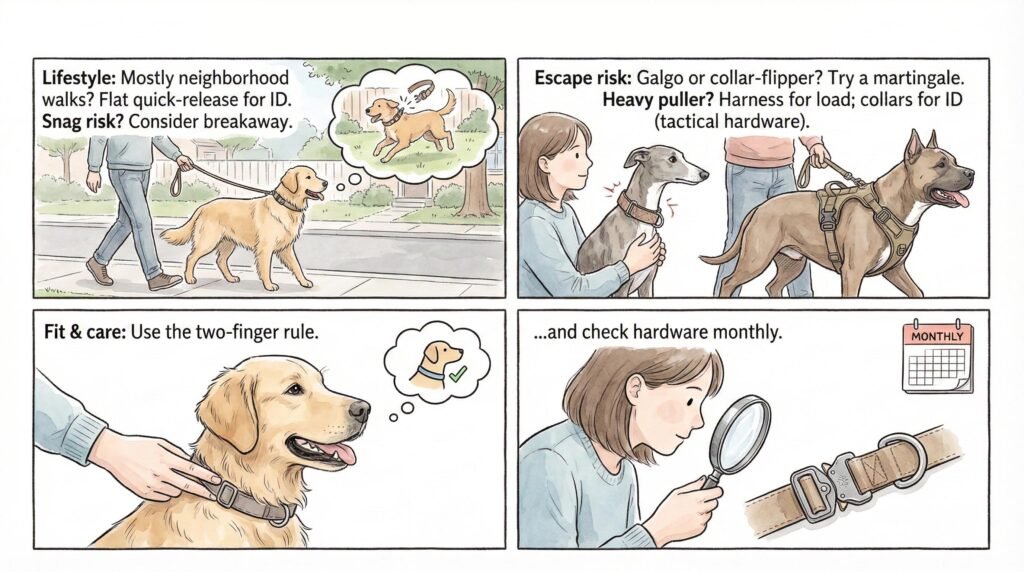
A flat quick-release (side-release) collar for everyday ID and on/off ease of use; breakaway if you have the snag risk; martingale for the escape artists; and walk on a well-fitted harness, not a collar, if your dog pulls like crazy or if you need more control.
This is the basic everyday collar: durable nylon webbing, a D-ring for tags or leash attachment and a side-release buckle that’s easy to open when you press both tabs. It’s popular because it fast to slip on/off, which people love if they need to easily remove a collar for grooming, daycare or emergency situations. Brand explainers stress the simple, intentional press-to-open design.
Everyday uses: apartment hallways and elevators, daycare drop-offs, beach days (quick rinse after), and anything where one-handed operation is beneficial.
Tip: Go with collars that have plates set into the a little so the tabs are not sticking out, and good buckle action; cheap hardware may bend or stick when sandy or icy. (We’ll get to an inspection checklist below.)
A safety-release collar is designed to pop open under pulling pressure, say if your dog’s collar gets caught on a fence picket or crate wire. The exchange (choosing a collar over the neck) is deliberate. It is not like quick-release, which opens only after you press the tabs.
Use when: Your dog is hanging out on its own in a yard with snag hazards, or you just feel like adding an extra layer of peace of mind around decks, vents or crates. Supervise on-leash walks — breakaways can open when you don’t want them to if the leash causes prolonged tension.
A martingale includes two loops a main loop and a control loop that cinches when pulled, but not as much as to choke which prevent narrow-headed dogs from slipping their flat collars (think: sight-hounds). Fitted properly, it should not close off the windpipe and is a combined favored of many trainers for walk training. Fit still counts (see two-finger rule).
A prong or pinch collar works by inflicting equal pressure around the dog’s neck with links that are equidistant from each other. If you work with one under professional instruction, modern quick-release latches like Herm Sprenger’s ClicLock can make it much easier to put on and take off without having to bend links every time, which is especially beneficial for handlers with limited grip strength.
From the author: This is an informational guide, and training tools should be selected with a professional dog trainer who utilizes humane, evidence-based methods.
| Type | How it opens | Best for | Pros | Cons |
|---|---|---|---|---|
| Quick-release (side-release) | You press both tabs | Daily ID/use, fast on/off | One-handed, controlled removal; great for daycare/grooming | Cheap buckles can flex; rinse after sand/ice |
| Breakaway (safety) | Force pops it open | Snag-risk scenarios | Reduces choking on snags | Can open when you don’t want it; leash with care |
| Traditional buckle | Thread + pin | Long wear, rugged | Familiar, robust | Slow to remove; awkward with gloves |
Key distinction: quick-release intentional press; breakaway force-activated safety release. source SPARK PAWS
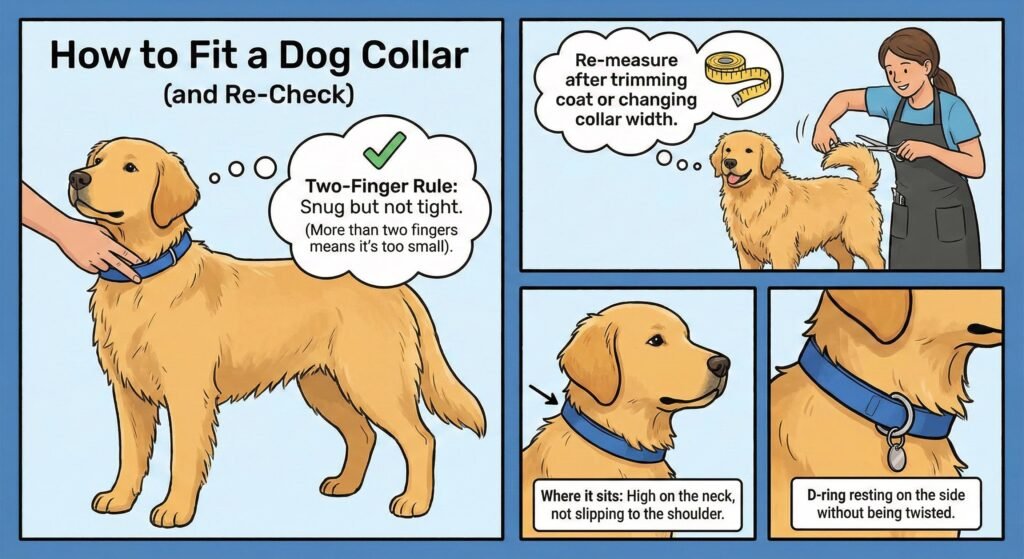
The two-finger rule. Fingers: Slide two fingers between collar and neck: it should be snug but not tight (more than two fingers means it’s too small). Re-measure after trimming coat or changing collar width. The AKC advice mirrors this fit test in their choosing the right collar recommendation.
Where it sits. They should sit high on the neck not slip down on to point of shoulder and have D ring resting on the side without being twisted.
Escape-artist note: If your dog tends to back out of flat collars, a well-fitting martingale collar, which tightens up but can’t be pulled over the ears, may help prevent slips.
Material & Construction / Methodry.rucksacks and goggles(or when heavy-duty matters) Tough materials are the only way to go if you want your bag to be as indestructible as LISSIE is.
The majority of collars we see on a daily basis are made with nylon webbing and acetal/polymer side-release buckles. For large pullers or working dogs, what you’ll instead find are tactical collars that use metal quick-release hardware such as AustriAlpin Cobra buckles a choice of some working-dog suppliers due to the ruggedness and convenient easy open/close under control.
If your dog is a major puller, switch weight to a harness for walks and reserve the collar for ID tags.
Harnesses distribute pressure over the chest/shoulders, and can reduce neck strain for pullers, small breeds and brachycephalic dogs. Most every harness you might be buying just for daily use fits quickly, too they prefer to call it a “quick-release buckle,” meaning two clicks or one click and you’re good to go (the Tru-Fit from this brand highlights “clip in a few buckles” and clip out with one).
Leash for the harness, ID for the collar.
Clip a front-clip harness on there if you’re working on loose-leash walking, and use the leash to connect to the front ring when you need discouragement from lunging.
If managing the clasp on a squirmy dog is awkward, magnetic quick-connect leash couplers help guide the two halves together; once clicked into place, they cannot be pulled apart — you depress the sides to release. And that one-handed operation is convenient in less than optimal lighting.
Read: /dog-leashes-quick-release (Pillar B) Looking for types of clasp carabiners, snaps, magnetic connectors and their care and handling.
In busy group classes I’ve seen quick-release buckles save the day: a dog panics under a chair, but press once and you’re in calm, controlled, no twiddling at a pin buckle. And that control is why I can recommend quick-release for day-to-day.
The quick-release flat collar is a perfect every day ID and for easy on and off. Pair it with a harness for walks (if your dog pulls).
A side-release-buckle collar that opens when you press both tabs quick to remove in grooming or emergencies, and useful for daily convenience.
Quick-release opens when you push the tabs; breakaway opens when force pulls it apart to lower the risk of choking if collar gets hooked. Different problems, different solutions.
If fitted properly, a martingale restricts how much it can constrict and helps to prevent dogs from slipping out of their collars. It should not choke when properly used.
There’s a two-finger rule: You should be able to slip two fingers comfortably between the collar and your neck not tight, but not too loose. Re-screen following shave or weight fluctuation.
If your dog pulls or you’d like to protect the neck, use a harness for leashes and the collar just for ID tags.
For big/working dogs, which are equipped with Cobra metal quick-release buckle, can be used for security and perfect fit, quick to open & close.
Dog collars aren’t one-size-fits-all. Choose walk on harness for pullers, quick-release for everyday convenience, breakaway for no-snag safety martingale if you’re worried about escape. Wire up the internal links above and you have a friction-less path through your entire quick-release ecosystem.