Table of Contents
Slip Lead vs Harness: When to Use Which
A slip lead is a leash- and-collar in one. Add a quick-release stop or center clip and you tighten/loosen in seconds ideal for fast on/off, controlled entrances/exits, prong collar converts and when training dogs for 5 minutes. Try proper fit, timing and a harness to train heavy pullers.
Key takeaways
- What it is: Rope/webbing that wraps around back of neck and has slide stop; some have a quick release tab/clip to instantly loosen.
- Why it’s great: Quick on/off at doors, vet, daycare; precise, momentary cues during training; fewer fumbling moments.
- What to avoid: Not over tightening, not leaving it on unsupervised and not using for long, pull heavy walks.
- Best practice: Teach fit, keep sessions brief, pair daily walking with a front-clip harness.
Slip Lead Basics (and What Quick-Release Means in This Case)
The standard slip lead consists of two parts:
- Once around your dog’s neck and a main loop that fits over the top of your dog’s head.
- Leather or plastic slide stop (it also determines how loose/tight it can be).
When they say quick-release in this context, it can mean two things:
- A low-friction stop or tab you can flick open to quickly slack the loop.
- A center clip or buckle that allows you to pop the loop off without having to pull it back over your head.
The point here, either way, is fast on/off times and a clean break-away when you want it.
When a Slip Lead Can Be Your Friend
- Threshold moments: Doorways, elevator lobbies, clinic check-ins loop on/off it in a second.
- Training reps: Brief, concise sessions where all you need is a brief cue and then instant slack.
- Fussy handlers or gear-shy dogs: No fiddling with collars or clips near ears.
- Field pickups/grooming: Those quick hands-on touches when you don’t want to change collars!
The wrong daily tool for this job is the slip lead, if your dog never stops pulling. Opt for a front-clip or Y-harness rather than that slip lead for everyday walks, and bring out the slip lead to tackle short training tasks.
Fit & Handling (The Safe Way)
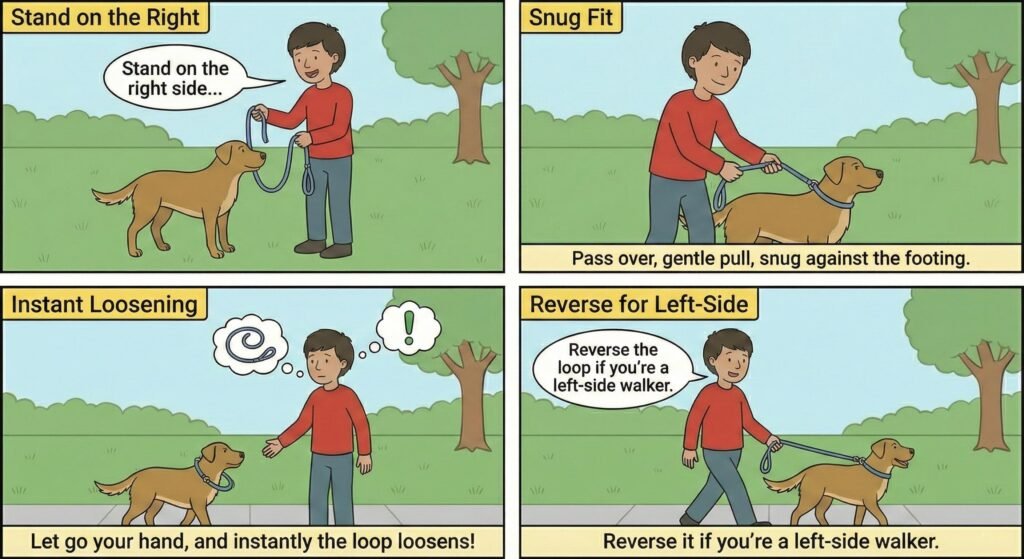
1) Orientation matters.
Stand on your dog’s right? The free end will pass over the neck and into the hand; give a gentle pull and it’s snug against the footing, let go your hand, and instantly the loop loosens. Reverse it if you’re a left-side walker.
2) Set the stop.
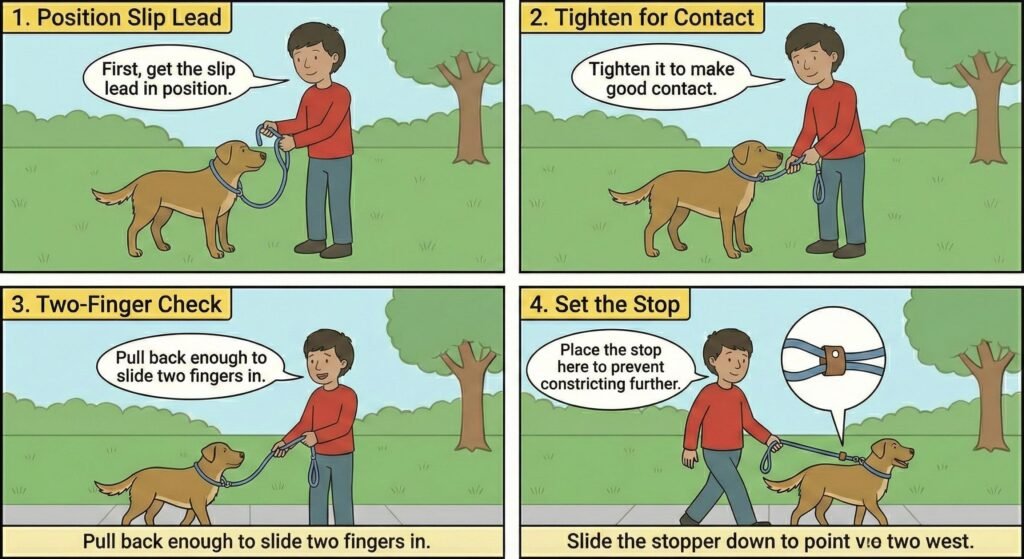
With the dog in a standing position, tighten the slip to where it makes good contact and pull back enough that you can slide two fingers between his neck and lead. Place the stop there so it can’t constrict beyond your preferred limit.
3) Cue-Slack.
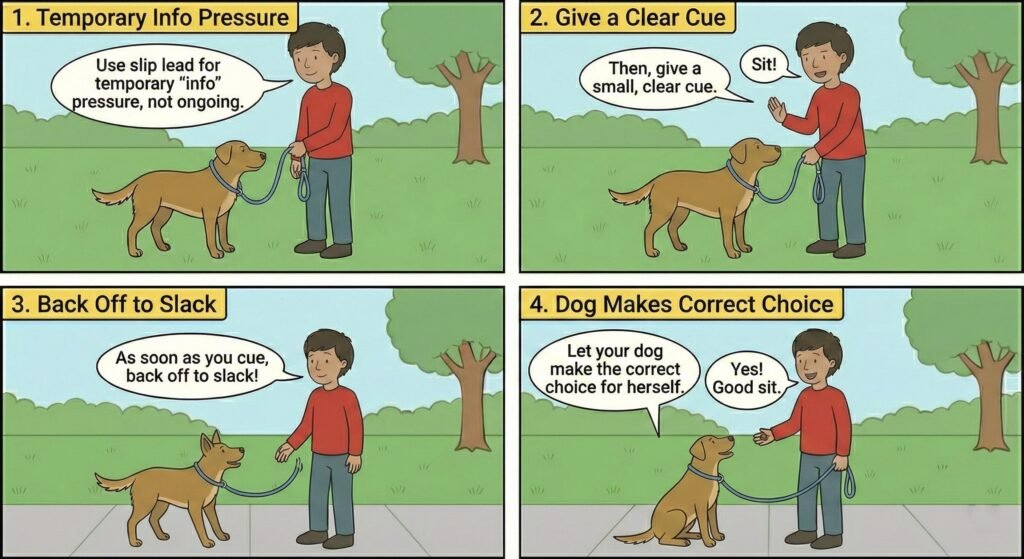
Slip leads are for temporary info pressure, not ongoing. Then give a small, clear cue — and as soon as you do, back off to slack so that your dog can make the correct choice for herself.
4) Never leave unattended without turning it off.
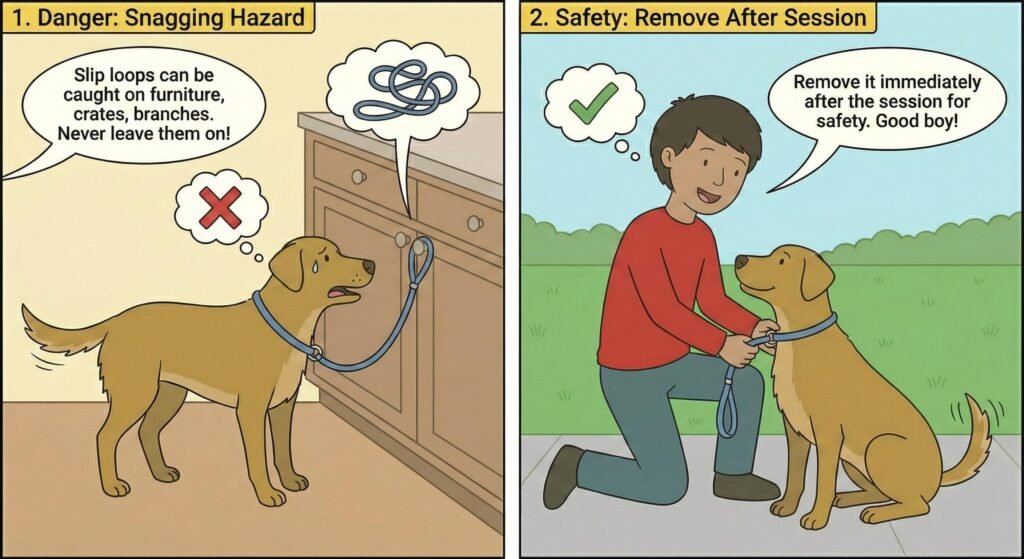
Slip loops can be caught on furniture, crates, branches. Remove it after the session.
5) Watch duration.
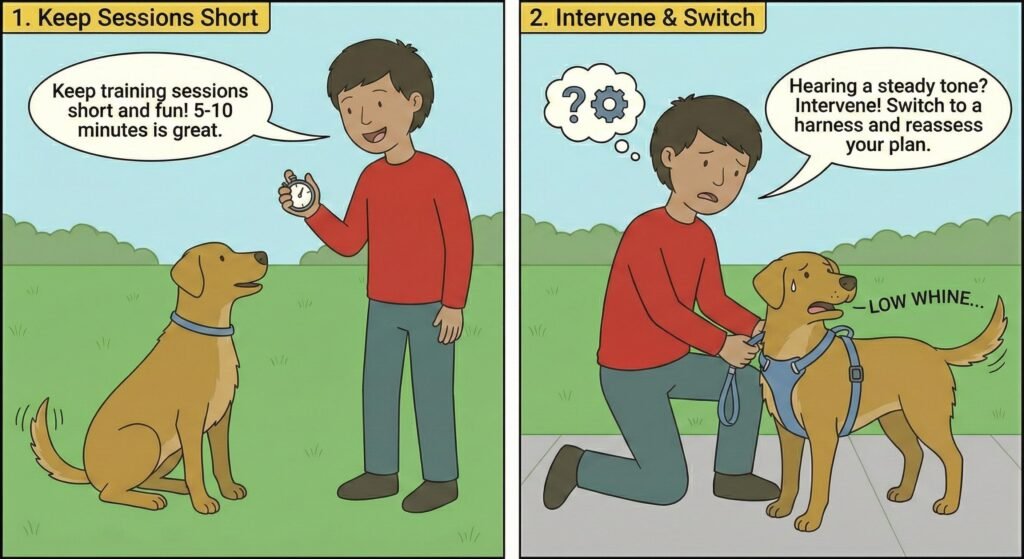
Keep sessions short. If you are hearing a steady tone from your dog, intervene and switch to a harness and reassess your plan.
Quick-Release Variants (Pick Your Style)
Low-Friction Stop Pull Tab
- Easiest upgrade: that stop opens with a gentle tug, so you can pop back for slack instantly.
- Best for: Trainers who don’t want any hardware near their head; Minimalist, lightweight feel.
- Note: Make sure stop will not be displaced, when being moved.
Center Clip (Micro Buckle)
- Tiny buckle on the opposite side of the leash end, just press to open loop and slide off neck.
- Best for: Dogs who don’t like things over their ears/eyes; handlers with dexterity issues.
- Note: Judge the smooth lines and clean release on the clip.
- Hybrid: Slip Lead and Quick Release Collar
Some set ups have a slip lead for only during entries/exits in addition to their dogs’ leisure ID collars. One you are over the threshold, however, remove the slip lead and walk on a harness.
Slip Leads vs Other Tools (What Changes Day-to-Day?)
| Tool | What it’s great for | Where it struggles |
|---|---|---|
| Slip lead (quick-release) | Fast on/off, brief cues, tight spaces | Long, pull-heavy walks; unsupervised wear |
| Flat collar + leash | Everyday ID and calm walkers | Slow on/off; not ideal for pullers |
| Front-clip/Y-harness | Reducing pulling, neck-friendly walks | Slightly slower to gear up |
| Head halter | Precision control for strong pullers (with guidance) | Requires acclimation; not a quick on/off tool |
Real-World Routines
Apartment/Busy Lobby:
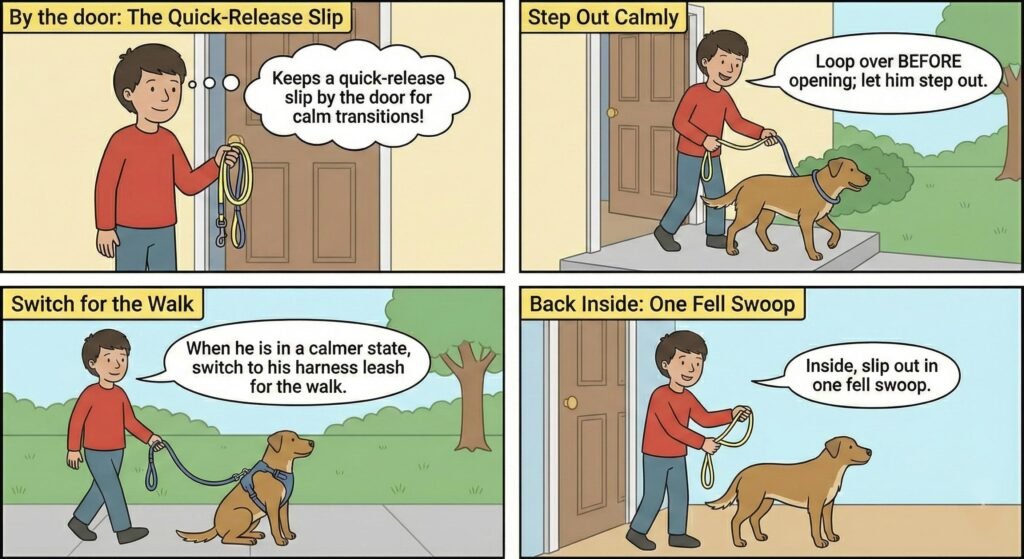
- “He kept a quick-release slip by the door.
- Loop over before opening; let him step out; and when he is in a calmer state, switch to his harness leash for the walk.
- Inside, slip out in one fell swoop.
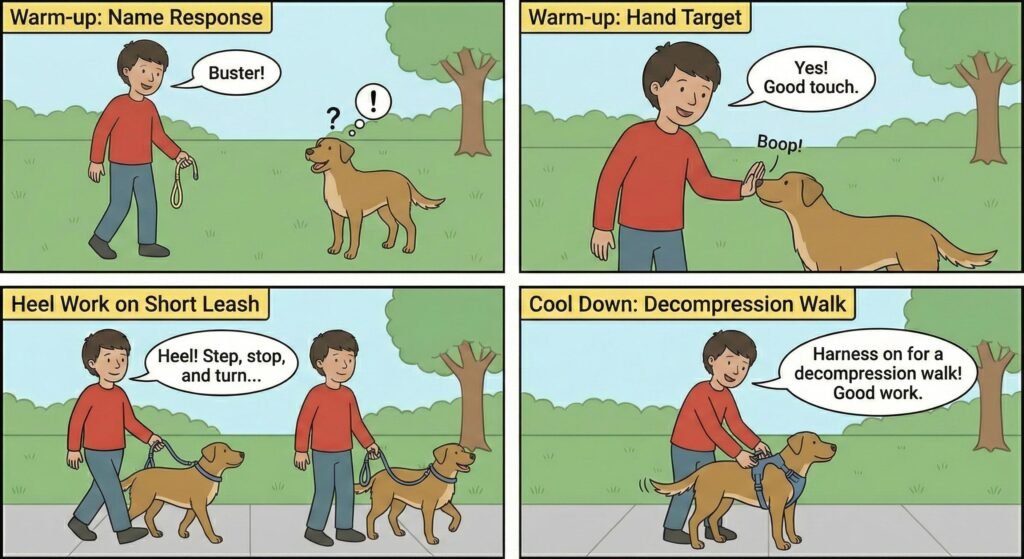
Training Session (10–15 minutes):
- Warm-up: name response, hand target.
- Heel work on a short leash: step, stop and turn cue then slack.
- Cool down: Put harness on for decompression walk to use.
Vet/Groomer Day:
- After slip Permission for parking pedestrian; Change to clinic equipment when requested; Remove after each use.
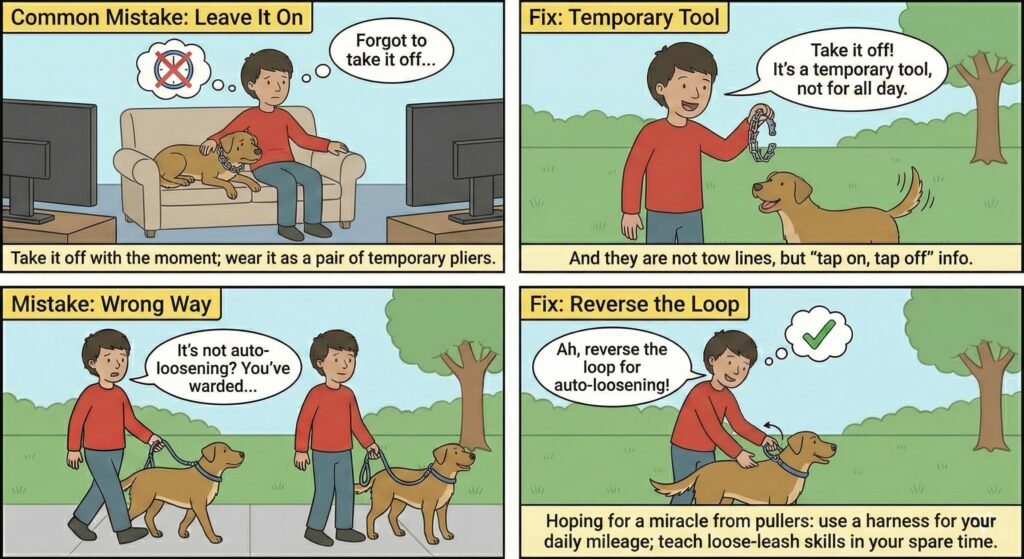
Common Mistakes (and Fixes)
- Leave it on: Take it off with the moment; wear it as a pair of temporary pliers.
- And they are not tow lines, but “tap on, tap off” info.
- Wrong way: It’s not auto-loosening? You’ve back warded reverse the loop.
- Hoping for a miracle from pullers: use a harness for your daily mileage; teach loose-leash skills in your spare time.
First-Hand Note
Quick-release slips gleam across thresholds parking lot to lobby, lobby to sidewalk. Loop continues in one smooth click, give a little “hey, with me,” then back to slack as the door swings closed. Then, once we are out and settled for the walk itself: I move to a harness (in this case) and an ordinary leash.
FAQs about Slip Lead vs Harness
Can a slip lead be used for daily walks?
It can be, but it’s not a great way to cover longer routes with lot of pulls. Save it for brief transitions or training; walk on a front-clip harness to rack up some miles.
Is a slip lead a choke on my dog?
No if properly fit and handled. Avoid making pressure constant by cue-slack and setting the stop at a safe point.
What’s the advantage of a quick-release on slip leads?
You can release and unsnap it immediately (via a tab or clip) and remove it all in one go, which is handy when you’re walking through doors, lobbies or have to deal with sensitive dogs.
Do I still need an ID collar?
Yes. Keep a flat collar upon which to hang ID, and use the slip lead only in brief instances when you must.
What if my dog backs out?
If your dog is an escape artist, keep a properly fitted harness or limited-slip martingale (for ID) on and use the slip lead only for supervised transitions.
Final Thoughts
Think of yours as a scalpel, not a sledgehammer. It’s great for those controlled, small touches to thresholds and training reps, then you can forget about it. For actual cragging miles, keep a front-clip or Y-harness to protect your dog’s neck and have the slip lead on deck for those times when speed and clarity are paramount.