Fact Check
Quick-Release Prong Collars: Your Most Asked Questions Answered
Make any prong collar a snap-around with this quick release buckle and center ‘press-to-open’ latch for added on and off convenience, Just slide it on or off in seconds no more links to bend. It doesn’t alter how the collar feels; it changes the moments around it: smoother setups, cleaner removals, safer handling.
Key takeaways
- What’s new: You get lightning-fast on/off with the center latch and a predictable emergency release.
- What doesn’t: It’s still fit- and placement-dependent, and it’s still a cue-slack system.
- Who it’s for: Coached handlers, cold climates, weak hands, active buildings.
- Daily miles: Utilize a front-clip harness; keep prong sessions short and focused.
FAQ: Quick-Release Prong Collars
What’s the deal with a quick-release prong collar, anyway?
It’s a slip collar with a center buckle/latch (commonly referred to as “ClicLock” style). You push to open, and click to close. No forcing links open near your dog’s ears.
Why it matters: Faster on/off makes dogs more calm at thresholds (doors, elevators), and provides you with an intentional emergency release.
Does a quick-release prong provide greater safety than one with regular prongs?
It’s easier for you to grasp: fewer awkward fumblings and a nice release. Humaneness still comes down to fit (high and tight on the neck) and how you work it (small cue, then relaxing immediately). The hardware is not an excuse to be handled tough.
Will the lock pop if my dog pulls?
It shouldn’t. The clasp is made to open only when pressure is applied. Pull-test immediately after hearing the click to ensure it has fully seated.
What should the fit of a quick release prong collar look like?
Placement High on neck, just passed ears, level all around.
Snugness: You could rotate it slightly, but not slip it over your ears.
Fit sizing: Adjust links until comfortable do not max out the closest fit.
Orientation: Make sure quick release is center accessible What You Clip: Where you naturally clip 5.
Do I still need a harness?
For the casual walkabout, as long as there’s pulling involved. Keep the neck safe with a front-clip or Y-harness and use the collar for ID or short, coached precision work.
Is a quick-release prong collar suitable for beginners?
Only with coaching. Teach fit, timing (cue-slack), and payoff. Short stints in boring places are better than long, high-stimulus walks.
How do I get it on and off without a mess?
Out: Pull the center to join position high → listen/feel for click → tug-test → clip leash.
Off: Stay → press the release → calmly separate ends (no metal bonking your dog in the face).
What are some pitfalls I need to be aware of?
Constant pressure. Move to harness; re-start training on micro cues-slack.
Over-tightening. Best fit by add/remove links, not by windlass.
Low placement. If it rounds down to the shoulders, refit high and even.
Skipping acclimation. Combine gear with treats for a couple of calm “on treat off” repetitions.
My hands are frail / I wear gloves. Will quick-release help?
Yes that’s one of its key benefits. The press-to-open center plate is easier than bending links with cold or arthritic hands.
Can I change my existing prong to quick-release?
Often, yes. Several models allow for a center pad and latch that is replaceable with a quick release. Verify compatibility (brand, link gauge) prior to purchasing.
Is a pinch collar the only way to stop my dog from pulling?
No. For pulling, the first choice is a harness (front-clip) combined with training and reinforcement for loose-leash walking. A prong (quick-release or not) is a precision instrument, not a tow vehicle.
How can I clean and service the latch?
Hose off when you return from sand/salt/snow; gritty deposits can clog latch channels.
60-second monthly check: positive click, smooth release, no cracking, no bent rings, rounded prong tips.
Retirets if you notice stiff buttons or hairline cracks, or if it gets deformed.
Mini Guides
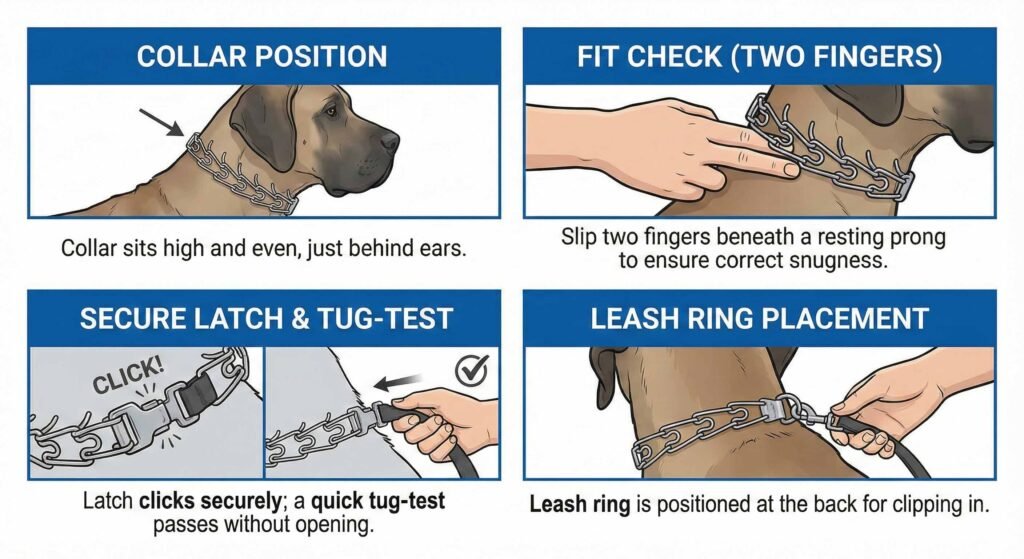
Quick Fit Check (30 seconds)
- Collar sits high and even.
- You should be able to slip two fingers beneath a resting prong.
- Latch clicks; quick tug-test passes.
- Leash ring at clipped in position.
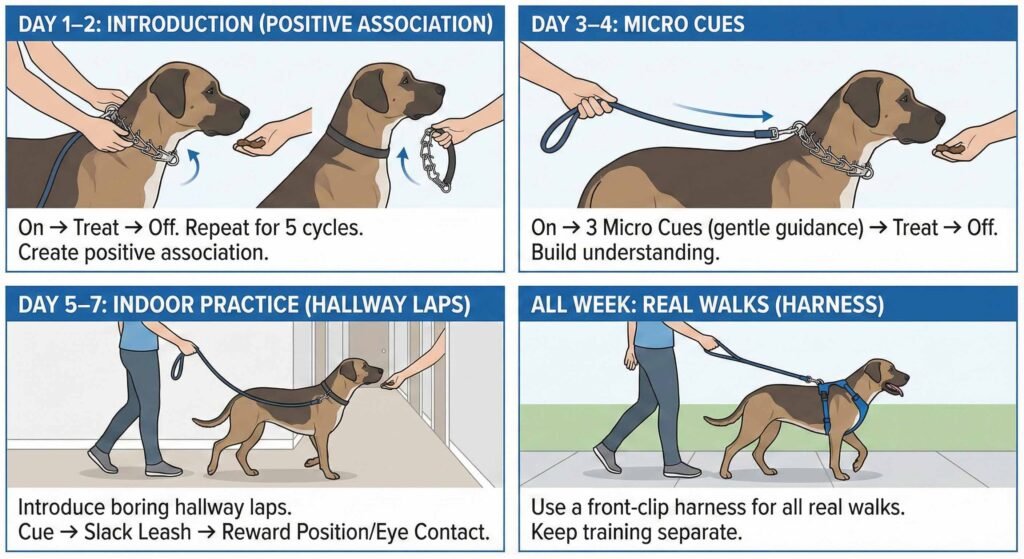
First Week Plan (10-minute reps)
- Day 1–2: On treat off (5 cycles).
- Days 3 or 4: On 3 micro cues treat off.
- Day 5–7: Introduce a boring lap of the hallway cue: slack reward position/eye.
- All week: Real walks on a front-clip harness.
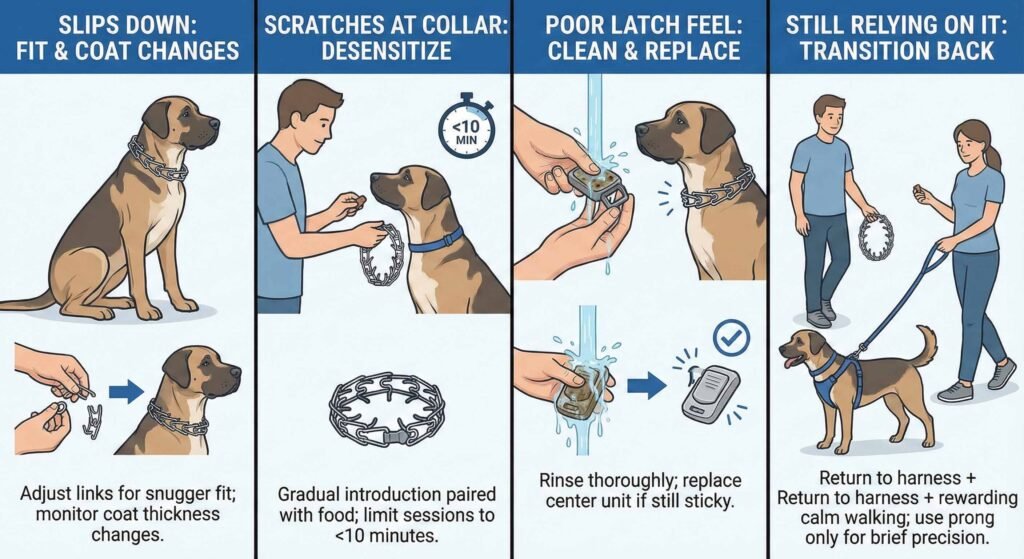
Troubleshooting
- Slips down: Adds/removes links for snuggier circle; monitors coat changes.
- Dog scratches at collar: Take it slow, gradually pair with food, limit training sessions to less than 10 minutes.
- Locking feeling of the latch is Poor: Rinse and if still sticky, replace the center unit.
- You’re still relying on it: back to harness rewarding calm walking; use the prong for brief precision.
Final Thoughts
A quick-release prong collar is a management upgrade, not a behavior shortcut. Haul some along to help maintain set-ups smooth, releases intentional and sessions short and clear. If your real issue is pulling, wear a front-clip harness on walks and save the prong for short, coached reps: Hike high and cue small; go slack in-between; make monthly checks non-negotiable.