Fact Check
Step-by-Step: Prong (Pinch) Collar: Putting it on and Fit
Table of Contents
9FAQs
Open one up, size it using adding/removing punches and make sure to settle the closed collar high behind the ears tight, even fit. You should get a nice solid click when it’s been seated (for quick-release that is) and have no slide over the ears. Carry as per cue relaxed and never continuous pressure.
The way you put on a prong collar determines how safe and effective it is for communication. If you’re still on the fence as to whether this type of collar is right for your dog, read Harness vs Pinch (Prong) Collar: What’s Right for Your Dog? can also help you decide before you start processing.
Tools & Prep (60 seconds)
- Flexible measuring tape (or piece of string ruler)
- Some extra links for your model/gauge
- Nice Light, quiet dog little towel (for use as grip)
- Optional: small pliers if you are breaking in a stiff band (gently don’t bend anything)
Part A: Assembling (Off Dog)
1) Identify parts
- Rounded-Tip Link (no sharp burrs or gaps)
- Center plate (to keep circle) or Quick-Release center (press-to-open)
- O-/D-ring attachment point(s)
2) Open a link correctly
- Pinch one link at the curved end, twist and pull apart the two tips.
- Don’t spread open that weakens the metal and makes the sharp edges.
3) Build a true circle
- Add or take out links to get the beginning length.
- Keep the orientation consistency when you connect them so that they lie flat without an “egg shape.”
4) If you are using a quick-release type center
Construct so the button is on the outside and the leash ring ends in a place where you conveniently clip it with your hand.
Before you even put it on your dog, test ride through several click open cycles.
Part B: Fit (On the Dog)
1) Place it high
- Put the closed ring high behind the ears and be level all around.
- The back plate should lay beneath the chin.
2) Snug, not tight
- You need to turn the collar a little.
- You shouldn’t be able to pull it over the ears.
3) Two-finger check
- Resting, you’re able to slip two fingers under a prong.
- If it’s looser than that, or if it keeps slipping down, unhook two buttons’ worth of links and reattach evenly.
4) Orient for handling
- Attaches on at the leash ring you’ll clip to naturally; quick-release space is reachable.
- Gently pull on it to be sure it’s seated.
First-Use Routine
- On treat off (3 reps) to create neutral, relaxed associations.
- Watch-say name → micro cue if necessary → slack → mark & treat (5 reps)
- Heel start: one or two loose steps then mark & treat → off.
- Switch to a front-clip harness for the walk itself.
While you’re learning placement and link management, it’s also worth considering how prong mechanics can affect various correction styles. Comparison in Pinch (Prong) Collar vs. Choke Chain: Noteworthy Differences elaborates on prospects of controlling when using a prong collar the difference in pressure and why.This is harmless for your pet if used correctly.
Gauge & Link Notes (Quick Reference)
| Gauge | Typical Dogs | Why Choose It |
|---|---|---|
| 2.25 mm | Small/medium; precision work | Lightest hardware, clearest micro-cues |
| 3.0 mm | Medium/large | Balanced clarity + durability |
| 3.2–3.8 mm | Large/strong | Sturdy; may dull subtlety on small dogs |
Rule: Use the lightest gauge that won’t get deformed under your dog’s normal load.
Troubleshooting
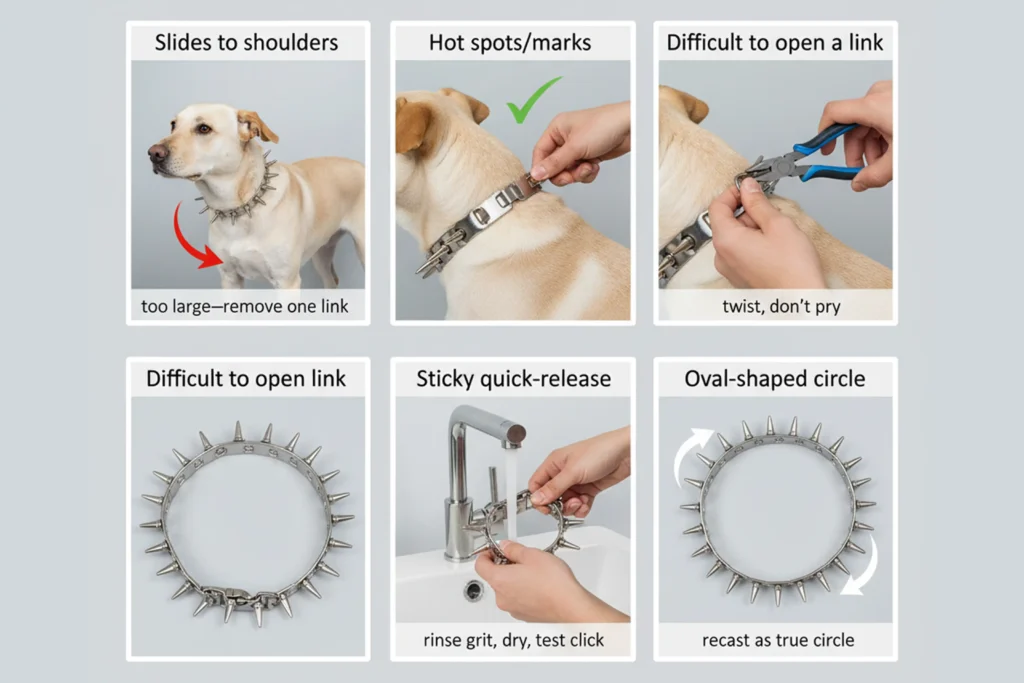
- Slides to shoulders: Too large/uneven > remove one link, recast as a true circle and re-center the plate.
- Hot spots/marks: You “made it work” by over-tightening → adjust by links, set to two-finger slack.
- Difficult to open a link: Grasp near the tips and twist, not pry wide. If not quite, apply light pressure with pliers and cloth grip.
- If the quick-release button feels sticky: Rinse (sand/salt grit happens), dry, test again. Replace if the click is weak.
- Oval shaped circle: Do not tighten all the screws at once but evenly disassemble and re-assemble; the circle must be a perfect one to get even pressure.
Safety & Maintenance (Monthly, 1 minute)
- Links/tips: “No cracks, no gaps, no burrs.
- Rings/plate: Welds intact; edges smooth.
- Release: Confident click, smooth press-to-open.
- Clean: Wash after sand/salt/snow, debris destroys latch seal.
- Re-fit: Coat/weight changes? Add/remove links.
Discard gear with very fine cracks, distorted links or dodgy release.
Common Mistakes (Easy Fixes)
- Sizing the way a flat collar fits → Prongs for right fit because links are not, prongs keep in place and do not unbuckle.
- Wearing throughout walk → Front-clip harness for miles; short, coached prong sets.
- Placement is low Re-size; placement needs to be high up behind ears.
- Pressure On,To Cue and Off → Switch to cue → slack, mark, reward.
From basic fitting to confident long-term use, be sure to follow the entire roadmap inside The Ultimate Prong Collar Guide: Care, Fit & Use for all things related to sizing, safety, leash cues and humane training progression.
FAQs
Where exactly do I measure?
Note the neck at the highest part/back of ear, level all around not mid-neck.
How tight is “snug”?
Two fingers under one prong; turns with slight pressure and will not slide down over the ears.
Do plastic/rubber tips change sizing?
No. They are a change of feel/appearance; the number and link count still define fit.
Does a quick-release center matter?
Short Leads: Great for doorways/elevators, gloves, or multi-handler homes–faster, calmer handling.
Will this stop pulling?
No. For real-world miles, practice on a front-clip harness and supplement loose-leash training. Only use the prong for short spool bits.
Final Thoughts
Fit easily, by links; set the collar high, close and even. Stay loose on your handling cue, quit while you’re ahead and continue the walk in a front-clip harness instead. Clear setup: short reps force and fiddling every time.