Fact Check
How to Size a Prong Collar for Your Breed
Table of Contents
Fit a prong collar to your dog’s high neck measurement (behind the ears) and pick the lightest gauge of link that holds its shape (frequently 2.25 mm for small/medium, 3.0–3.2 mm for large). Final fit will be achieved with addition/removal of links to achieve a high, snug and level collar (it may rotate slightly but should not slip down over the ears). It is hard for a universal sizing system to accommodate the various neck shapes, thicknesses of fur and differences in musculature of distinct breeds. How to Take Starting Measurements To take your starting measurements start here: Prong Collar Size Chart: How to Measure Your Dog for a Prong Collar.
How This Guide Works
Breed heads and coats are different treat the table below as guidelines. You’ll still make the high, even circle with your dog by adding/removing links.
Starting Points for Fast Breeds (Then Tweak)
Option for a light gauge that won’t bend under the weight of your dog’s average load.
| Breed / Type | Typical High-Neck Range* | Starting Gauge | Link Notes | Fit Watch-outs |
|---|---|---|---|---|
| German Shepherd / Malinois | 15–18 in (38–46 cm) | 3.0–3.2 mm | Med/Large base + 0–3 links | Thick double coat shifts with seasons; keep spare links |
| Pit Bull / Bully mixes | 14–17 in (36–43 cm) | 3.0 mm | Med base + 0–2 links | Muscular necks ensure truly high placement |
| Labrador / Golden | 15–19 in (38–48 cm) | 3.0 mm | Med/Large base + 1–3 links | Coat density varies; re-fit after grooming |
| Husky / Akita | 14–18 in (36–46 cm) | 3.0–3.2 mm | Med/Large base + 1–3 links | Winter coat can require +1 link; spring −1 |
| Boxer / Doberman | 14–17 in (36–43 cm) | 3.0 mm | Med base + 0–2 links | Short coat: watch for over-tightening “to make it work” |
| Rottie / Cane Corso | 18–22 in (46–56 cm) | 3.2–3.8 mm | Large base + 1–4 links | Heavy hardware; keep circle even for comfort |
| Aussie / Border Collie | 12–15 in (30–38 cm) | 2.25–3.0 mm | Small/Med base + 1–3 links | High stamina pullers—use harness for miles |
| Beagle / Cocker | 11–14 in (28–36 cm) | 2.25 mm | Small base + 0–2 links | Ensure snugness or it will slide to mid-neck |
| Frenchie / Pug (brachy) | 12–15 in (30–38 cm) | 2.25–3.0 mm | Small/Med base + 1–3 links | Often better to walk on a harness; keep prong sets very short |
| Toy breeds (Yorkie, Chihuahua) | 9–11 in (23–28 cm) | 2.25 mm | Small base + 0–2 links | Prioritize light hardware; confirm two-finger slack |
Measure around the dogs neck at the highest point, right behind the ears while your dog is standing.
Step-By-Step: Breed-Aware Fitting
- After taking your measurement of the high Neck behind the ear during in inches or cm.
- Choose starting gauge from the table (err on the small side if you would like finer signals).
- Set the tile to a beginning collar length, high and level.
- You keep adding and removing links until you are able to rotate it some, but you can’t slide it over the ears.
- Check two fingers under one prong at rest.
- Reverse the middle plate and leash ring around the point where you grip.
- If it’s a quick-release, ensure there is a robust “click” and crisp press-to-open.
Once you’re aware of your dog’s size and anatomy, it is time to double check the adjustments on that link. Measure Once and Fits Right: Prong Size Guide provides a detailed walk through for a comfy, yet snug fit. It should rest in place without pressure points.
Breed Notes & Nuance
1. German Shepherd / Malinois
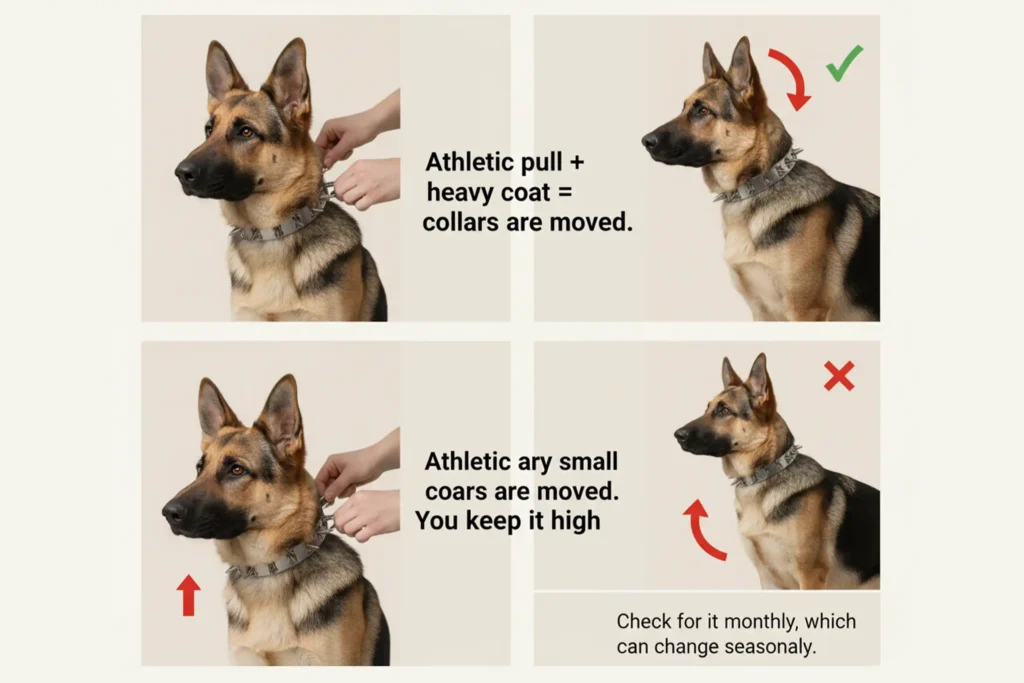
Athletic pull + heavy coat = collars are moved. You keep it high and you should check for it monthly, which can change seasonally.
2. Bully Breeds (Pit Bull, Am Staff)
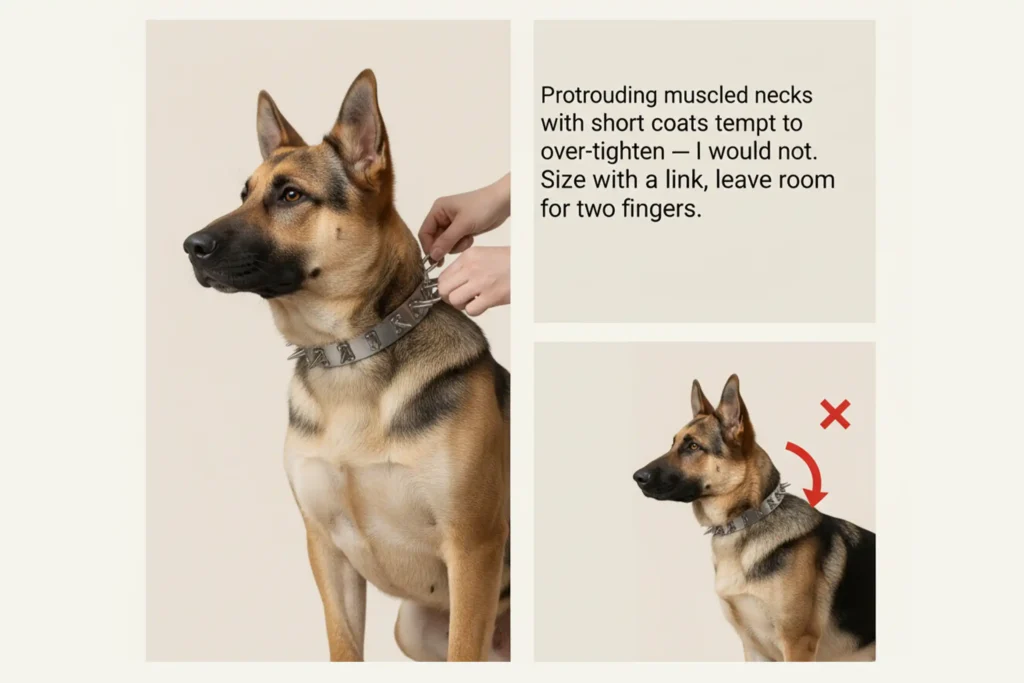
Protruding muscled necks with short coats tempt to over-tighten I would not. Size with a link; leave room for two fingers.
3. Nordic Double-Coats (Husky, Akita)
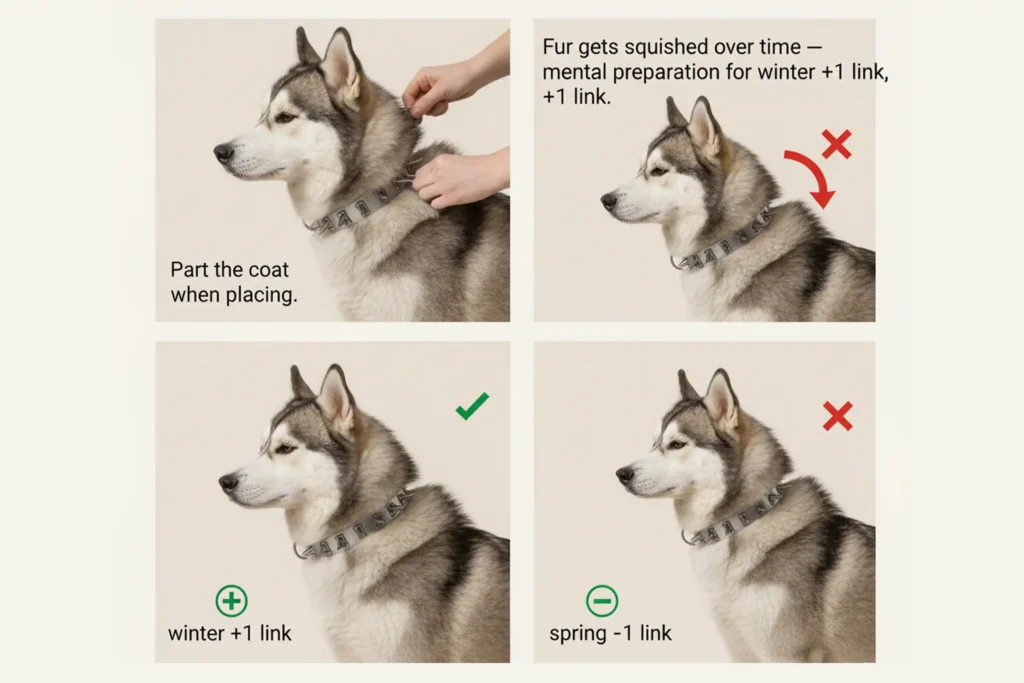
Fur gets squished over time mental preparation for winter +1 link, spring −1. Part the coat when placing.
4. Retrievers (Lab, Golden)
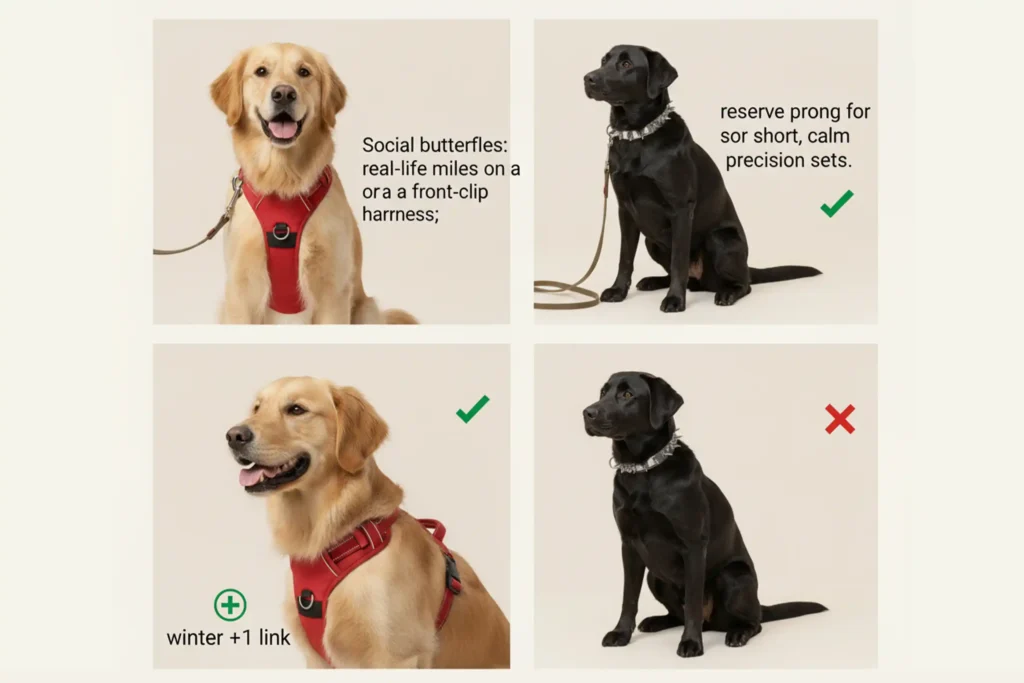
Social butterflies: real-life miles on a front-clip harness; reserve prong for short, calm precision sets.
5. Brachycephalics (Frenchie, Pug)
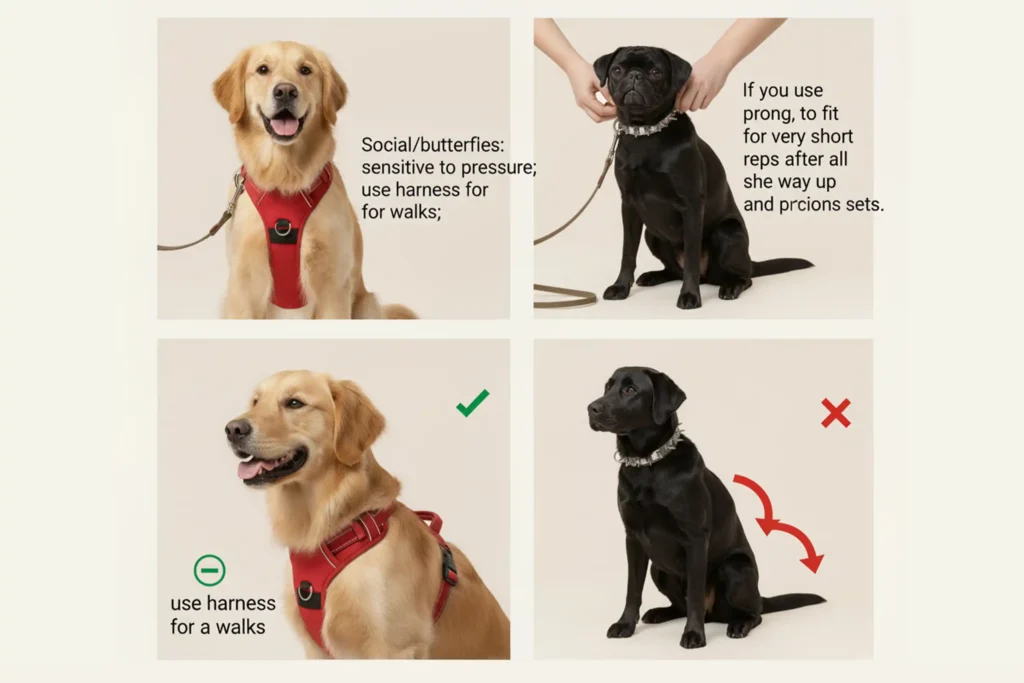
Neck/airway: sensitive to pressure; use harness for walks. If you use a prong, to fit for very short reps after all the way up and even.
6. Toy/Small Breeds
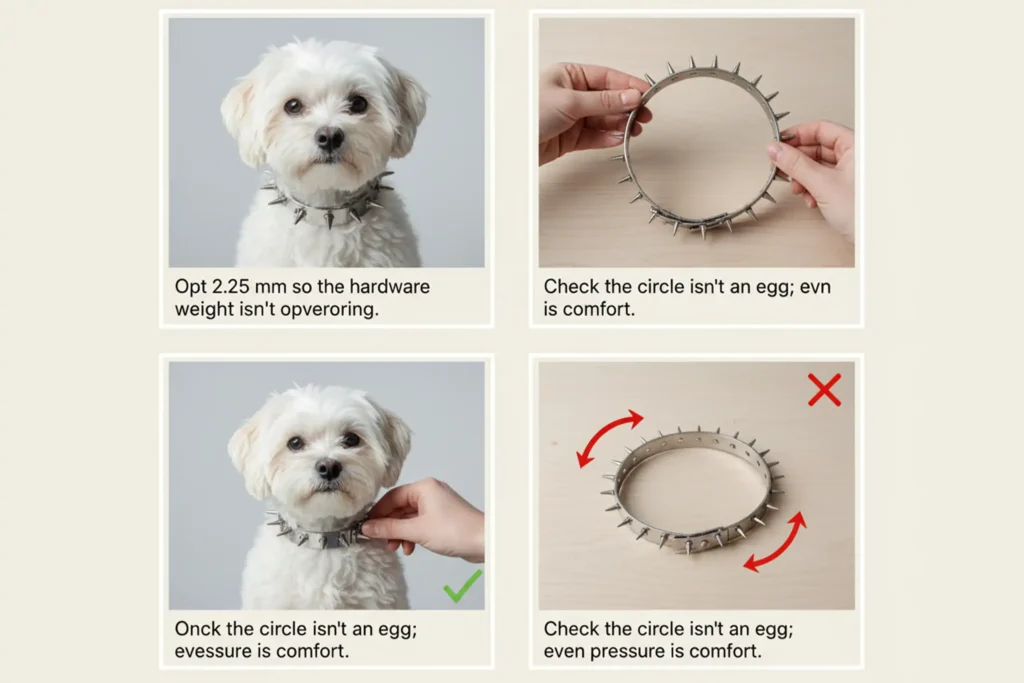
Opt 2.25 mm so the hardware weight isn’t overpowering. Check the circle isn’t an egg; even pressure is comfort.
Common Fit Problems (Fast Fixes)
- Slides work to shoulders: If the Collar is too large or uneven → Remove a link, (re)make it into a nice circle, center the plate.
- Hot Spots/Marks: You over-tightened it (to tension, then tighten) → try again, let off, remove/add a link or 2, restore the two-finger slack.
- Oval circle: Dismantle completely, rebuild the same way; inner plate in the middle.
- Clicks but slips: Height, not just tightness raise it up, then re-size by links.
Quick-Release Centers (Will It Affect The Breed Size?)
No, the math of sizing is the same. They do aid in threshold calm (door, elevators) and are good for gloves/low grip strength or multi-handler households.
When You’re Pulling & On Long Walks use a Harness
Regardless of breed, control miles on a front-clip or dual-clip harness and leave a flat collar for ID. Put the prong in for short, precise training then snap it back on to the harness.
As soon as you know your breed-specific size, move on to safe fit, placement and handling with The Ultimate Prong Collar Guide: Care, Fit & Use.
FAQs about Size a Prong Collar
Do long-haired breeds need bigger collars?
Not larger just link adjustments as coats change. Keep the collar high or low, no exaggerating; add or remove a link, depending on the seasons.
The collar of my GSD is continuously slipping. Fix?
Take out a link, form the circle again and then make sure the center plate is also in center. High placement is non-negotiable.
3.0 mm or 3.2 mm for a powerful Pit Bull?
Begin with 3.0 mm Clear; go up to 3.2 mm only if the collar distortions. For real miles, use a front-clip harness.
2.25 mm small on a small breed by still bulky help?
Be sure the circle is true and links aren’t over-spread. Interface with hardware should be minimal, and must ensure high positioning.
Final Thoughts
Breed guides are starting points, not end results. The victory, too, is the same: high, tight and mild accomplished by links, not force. Choose the lightest wire gauge that holds for your dog, re-check fit as coats fatten and thin, and clip leash to front-clip harness for daily miles. Clean fit clear communication whatever the breed.