Fact Check
Magnetic Leash Connectors: The Easiest Way to Clip On
Table of Contents
The magnetic leash connector uses powerful magnets to auto-align the two pieces and then the mechanical latch snaps shut allowing you one-handed, eyes-off attaching. They’re disingenuous-is: They are not based the strength of the magnet keeping your dog inside they have the mechanical lock that then carries load once locked.
Key takeaways
- Why they’re great: Faster, cleaner clip-ins at doors and elevators (and nighttime curbs) excellent if you have bags or gloves to manage.
- How they work: Magnet pulls pieces together latch closes you tug- check. Release is a press (button/tabs), not a pull.
- Best for: City walkers, parents with strollers in tow, and those unable to manipulate a regular leash (for example, when they’re wearing thick gloves).
- Watch-outs: Add a little tug-check; do make sure it fits you in width with your collar/harness D-ring; some are heavy.
What Exactly Is a Magnetic Dog Leash Connector
It’s a two-piece coupler that sits between your leash and your dog’s D-ring. The built-in magnet points it for you; a spring or cam latch does the locking. That means you can clip in one-handed, while click-clacking with a door or coffee (or dog treats).
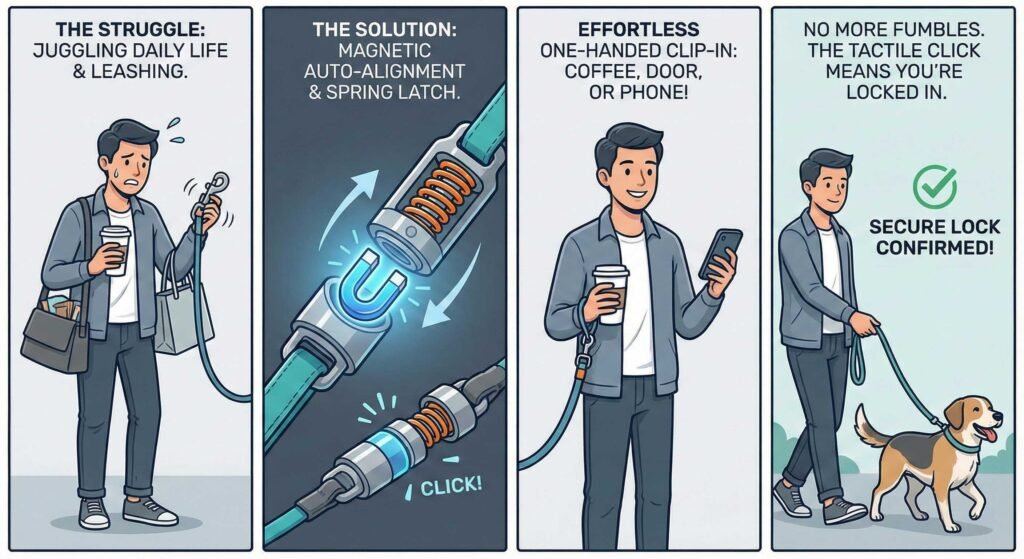
Why it matters: In real life, fumbles come in bands. The auto-alignment shaves off seconds, where a dog could lunge ahead, and the tactile click lets you know you’re locked in.
The Varieties of Magnetic Systems (Choose Your Style)
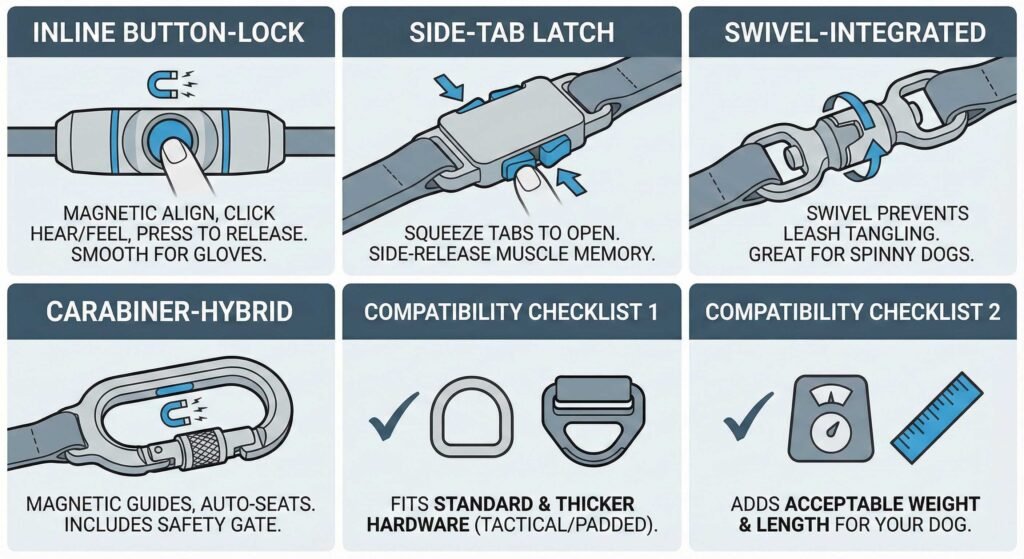
- Inline Button-Lock: Magnetic alignment, click you can hear/feel, press button to release. Smooth for glove use.
- Side-Tab Latch: Squeeze tabs to open; muscle memory if you already use side-release buckles.
- Swivel-integrated : the connector is fitted with a swivel that helps prevent leash tangling great for spinny greeters.
- Carabiner-Hybrid: Magnetic guides a micro-carabiner that auto-seats; some include a safety gate.
Compatibility checklist
- Fits standard collars and D rings on harnesses.
- Open is wide enough for thicker hardware (tactical collars, padded harness loops).
- Adds to your dog’s weight/length in as acceptable size for your dog.
Magnetic vs Non-Magnetic Clips (Day-to-Day Reality)
| Feature | Magnetic Connector | Standard Clip (snap/carabiner) |
|---|---|---|
| Clip-in speed (one hand) | Fastest (auto-align) | Fast (requires aiming) |
| Night/low light | Excellent (eyes-off) | Okay (you hunt the ring) |
| Gloves/dexterity | Excellent | Varies by clip |
| Weight | Medium (model-dependent) | Light → Heavy (wide range) |
| Security | High (mechanical latch) | High (locking carabiner) / Good (snap) |
| Best for | Thresholds, city life, multitasking | Heavy pullers (locking carabiner), general use |
Bottom line: Magnets reduce clipping pain. If your pain point is pulling, choose a locking carabiner and front-clip harness a magnetic connector can still be added in front of that carabiner there just have to be something on the system that it could attach to.
Safety & Energy: What You Need to Know
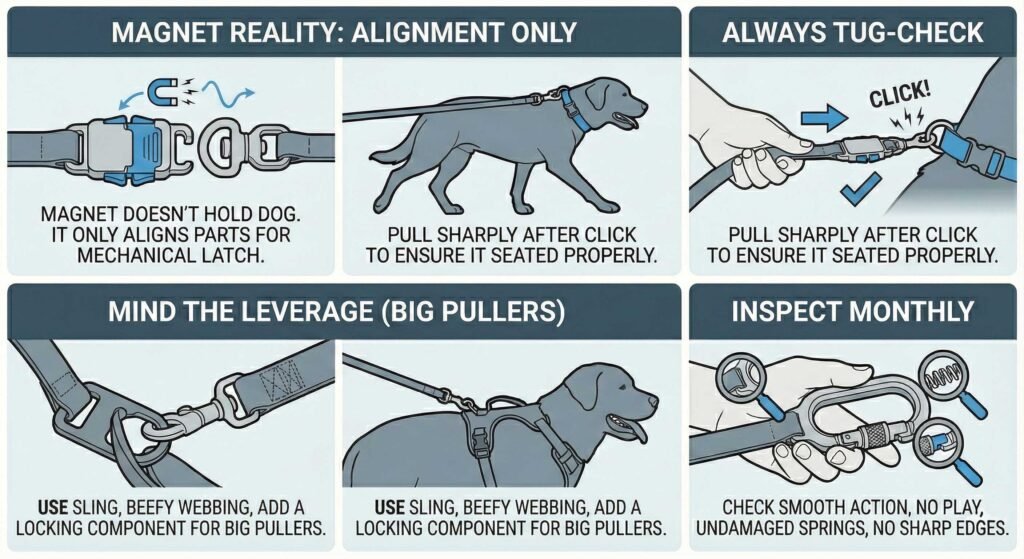
- Magnet doesn’t hold your dog. It doesn’t do anything except line up the parts so that the mechanical latch can physically close.
- Always tug-check. Pull sharply when it clicks to ensure that it seated properly.
- Mind the leverage. With big pullers, clip onto a sling and use beefy webbing; if your connector can handle it, add a locking component.
- Inspect monthly. Check for smooth latch action, absence of play in the hinge, undamaged springs and no sharp edges.
Use Cases You’ll Actually Feel
- Elevators & lobby doors: Clip in while keeping the door at bay with your other hand.
- Night walking: No more searching for the D-ring – the connector does that.
- Cold mornings: Gloves never take off; press-to-release trumps tiny gates.
- Reactive levels: 3 Faster clip-in/out when it matters most.
Setup Recipes
City Everyday (most owners):
- 5–6 ft nylon/Bio-thane leash and/or strong magnetic connector rear-clip harness.
- Toss in reflective stitching a traffic handle.
Parent/Stroller Mode:
- Hands free belt leash, magnetic connector at dog end.
- Keep a short grab tab handy next to the dog for curbs.
Tiny Dog Setup:
- 3/8” ½″ webbing leash (Your laps or hands will thank you) lightweight magnetic device.
- Ensure the connector doesn’t ‘bonk’ the chest; turn D-ring if necessary.
Adventure Add-On:
- Strength: Auto lock carabiner, rope/webbing (also with magnetic guides if applicable)
- Features: Swivel between your leash and connector to avoid tangles.
Maintenance (30-Second Routine)
- Give it a rinse after the sand/salt/snow grit kills little springs and latch channels.
- Dry-lube the hinge for metal (counters no greasy residue).
- Make sure there’s a clean, confident click, followed by smooth press-to-release action.
- Retire them if you notice hairline cracks, sticky buttons, or a wobbly joint.
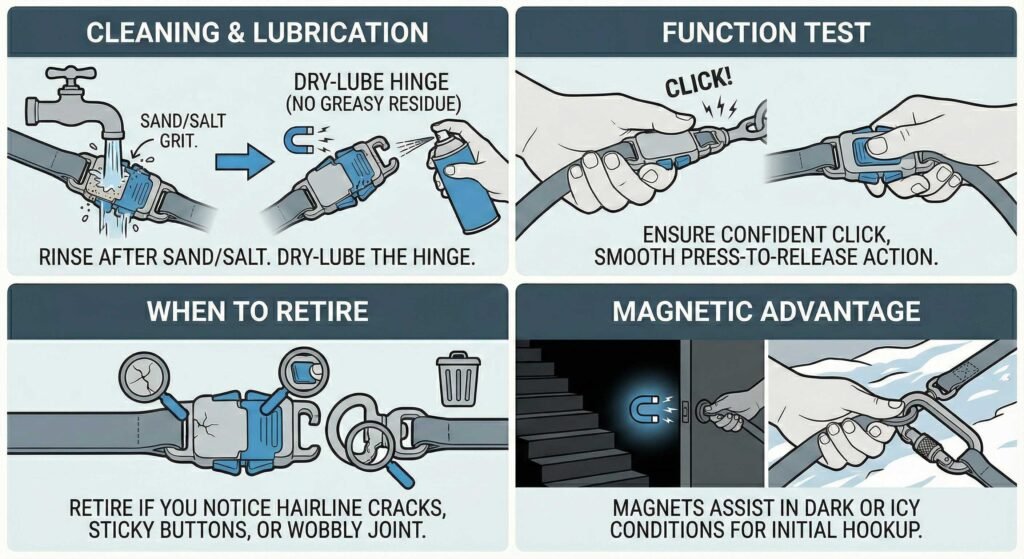
In pitch-black stairwells, magnets are cheating the connector goes right to the D-ring as I hold open the door. On icy trail days, I still want an auto-lock carabiner for load but I’m a fan of a magnetic assist for the initial hookup.
FAQs abut Magnetic Leash Connectors
Are magnetic clasps safe for strong dogs?
Yes, if the mechanical latch is strong enough and you use it together with a harness (and even a locking stage, provided you have one in your setup). The magnet is just the guide.
Will it come off if I have a strong pulling dog?
Not if it’s properly latched. Do a quick pull-test after the click; your mechanical lock should now start carrying the weight.
Will they fit all collars and harnesses?
Most will fit a standard D-ring, but some may require a wider mouth for padded loops or thicker tactical rings. Check specs.
They are strong for a little dog?
Some can be. Select small models for toy/small breeds and make sure the connector is not on their chest.
Can I walk one with a slip lead?
Most of the time not something for the connector to grab. Use with collars/harnesses.
Final Thoughts
Magnetic leash connectors fill the actual bottleneck of finding a clean clip when life is messy. They aren’t going to supplant strength hardware for freight-train pullers, but they’ll make 95% of doorway moments nicer. Pick a unit that is compatible with your D-rings, do a quick tug-check, and match with a harness if your dog loads the line. Faster clip-ins, calm exits that’s the win.