Fact Check
Prong Collars (ClicLock) Quick-Release Prong Collars: Safer, Faster, Easier
Table of Contents
A ClicLock-style quick-release in the middle of a prong collar that allows you to put it on and take it off in seconds with no more cold, fingers-bending-links situations. It makes sessions less excitable, enhances safety in confined spaces and benefits handlers with reduced grip strength.
Key takeaways
- What it is: A prong collar with a center quick-release buckle (“ClicLock” is one version) press to open, click to close.
- Why it works: Quick on/off, predictable release in tight spots and reduced fumbling with metal links.
- Best for: Coached handlers, dexterously or gloved folks with less grip strength, and short training reps.
- Rules: the right fit & float proper placement, cue-slack handling & a harness for daily mileage/pull-heavy walks.
What ClicLock-Style Quick-Releases Actually Do
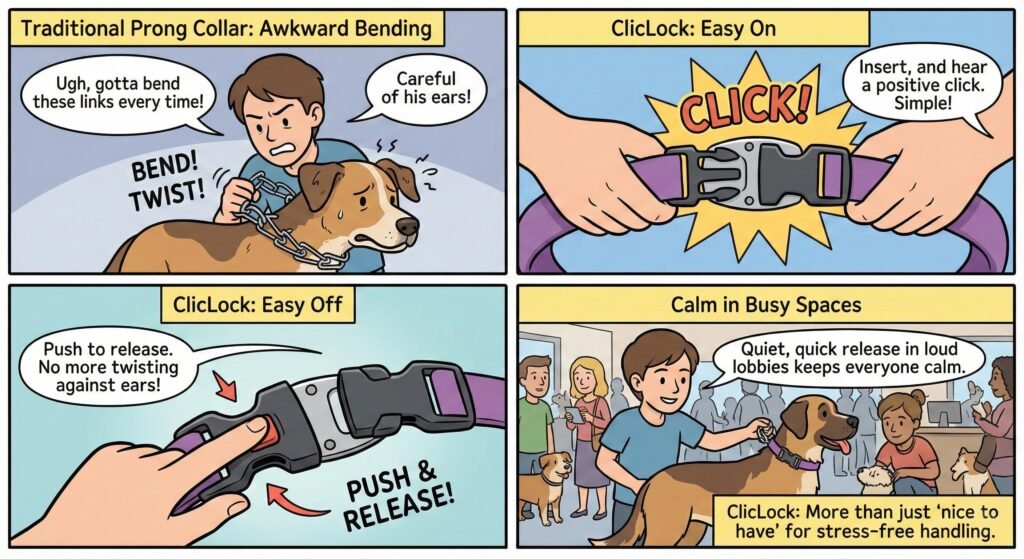
Prong collar need to be unbent and bent to open and close Traditional style prong collars are awkward to use because you must bend your links in order to link them together. ClicLock places a press-to-open buckle on the center plate:
- At: Insert the two halves, and you will hear a positive click.
- Off: Push the release; the collar center opens no more twisting links against your dog’s ears.
A setup like this is more than just “nice to have,” especially for larger organizations. When pulling in loud or busy lobbies and cramped doorways, the ability to release on purpose without yanking keeps the moment calm.
Fit & Placement (Non-Negotiable)
Quick-release or no, though, the fit of any prong collar is make or break.
- Position: High on the neck, back of ears and all around.
- Snugness: You can move the collar some, but it should not be possible for it to go over the ears.
- Sizing: Link in or out to size; do not over-tighten to “make it work.”
Hardware orientation: Position the quick-release midway and where you can reach it easily; rotate the leash ring to your clipping preference.
Two-minute training: Clip, pull gently to ensure it’s seated properly, then practice the release once while your dog is calm.
Handling: Cue-Slack (How to Use It Positively for your dog’s well-being)
Imagine the collar as a microphone, not a megaphone.
- Micro cues: Supply a small, specific cue; immediately return to slack.
- Mark & pay: Reinforce the behaviors you want (eye contact, position changes) so your dog knows what gets him relief and reinforcement.
- Conscious repetition: Five to 10 minutes is greater than an hour.
- Setting ladder: Begin in undisturbing environments; introduce distractions over time.
If you’re maintaining steady pressure, drop back to a front-clip harness and refresh training mechanics.
Who gains the most from prong collars, quick-release?
- Those with weak grip strength/arthritis: No bending links anymore; the button will do it for you.
- Cold climates: Gloves on, though not ideal.
- Busy buildings: Elevators, vet doors, daycare hand-offs the regular on/off rigamarole.
- Led by: Trainers who coach brief, controlled reps wanting seamless transitions.
Who probably doesn’t need it?
- Owners of dogs who already trot along nicely on a harness (just keep doing that).
- Dogs who are exclusively prickly on leash: 6-ft of front-clip harness, save the prong (if you even use and as required, I didn’t) for short training sets.
Safety Checklist (60 seconds, Once a Month)
- Click check: The latching device stays closed and will not stick.
- Link check: Not gapped, cracked or with bent prong ends and turned shape gapless.
- Ring check: Welded/solid leash ring and center plate; no wiggle or sharp edges.
- Clean: After sand / salt; grit is latches and chews finish.
- Fit refresh: Coat/weight changes? Adjust links.
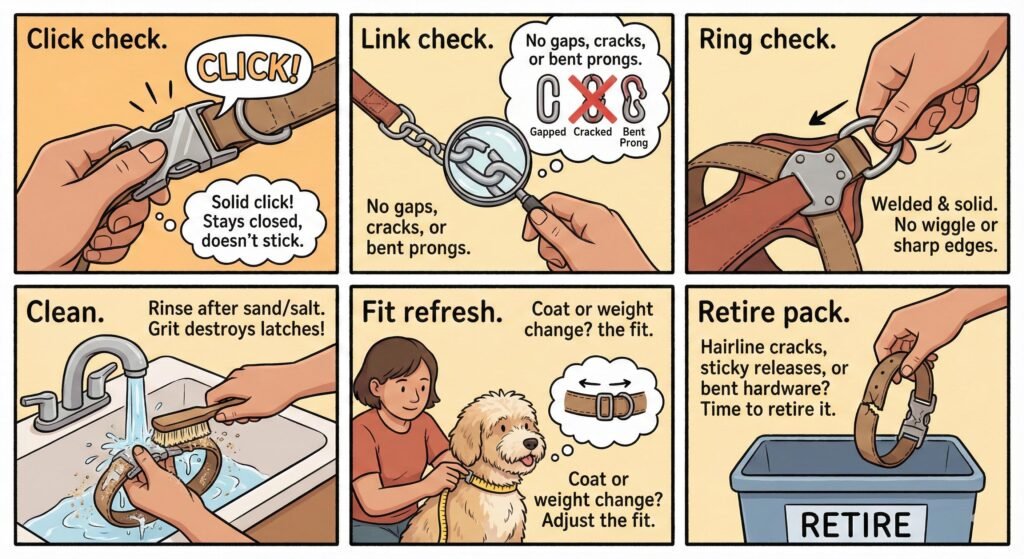
Retire pack with hairline cracks, sticky releases, or bent hardware.
How to Wear It (Step by Step)
- Chill scene: Stand/sit in a place where your dog can chill.
- High set: The collar should be placed high behind the ears.
- Click closed: Hook the center plate, and listen for click.
- Tug-test: A gentle pull on the ring to verify that it is not being pulled away.
- Clip leash: Clip onto the D ring or the center ring as directed by your model.
- Build a foundation slowly: 1 or 2 micro reps treat / reward end session on success.
Removing Cleanly
- Keep the collar still, and push a release.
- Let the ends part, resisting any urge to drop metal near your dog’s face.
- Praise, treat, done.
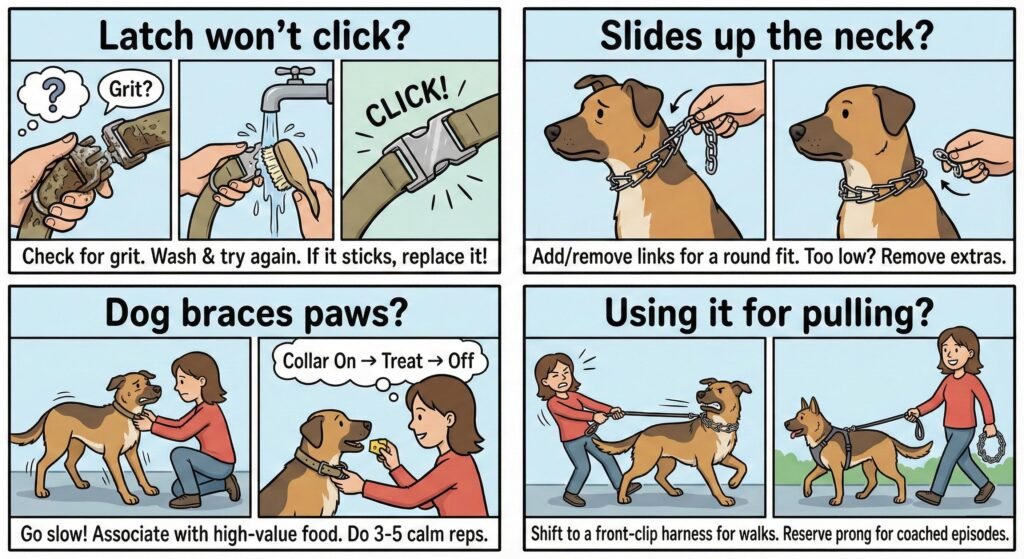
Troubleshooting (Fast Fixes)
- Latch won’t click: Look for grit; wash and try again. If still sticky, either replace or retire the latch unit.
- Slides up the neck: Chain a link or two for roundness, and remove any extras if it’s sitting too low or uneven.
- Dog braces paws at collar: Go slow; associate the gear with high-value food to begin and 3–5 calm “collar on → treat → off” reps before real training.
- You’re using it for pulling: Shift to a front-clip harness when you walk; reserve prong use for short, coached episodes.
Real-World Routines
Busy Lobby Reset (3 minutes):
- Enter on front-clip harness.
- Change to quick release prong for 2 minutes: watch → step → reward → slow.
- Unclip and return to the harness before you head out for real.
Cold-Hands Setup:
- Prep at indoors; walk out; when you need a curb level of precision, click it on, run 2–3 cues, hit to release and clip back up into the harness.
Handler With Dexterity Limits:
- Train the press-to-open while sitting down, with treats, until it’s fluent.
- Leave a short grab tab on the D-ring for easier clipping if you will be using a hook-ended leash.
FAQs Prong Collars Quick-Release
Teach them to walk with a quick-release prong collar.
It’s safer to kick quicker on/off and predictable release if fitted and handled correctly. Good granting of the rein still remains dependent on cue-slack, not pressure constant or otherwise.
Will the latch release if my dog pulls?
No it’s active only when you press the machine’s mechanism. And you should always give it a quick tug after your hear that Click.
This can be used for daily walks?
For walking miles, if walks are simply full of pulling all the time, use a front-clip harness and save the prong (if you have been using it) for short coached sessions.
What size should I buy?
Check the brand’s size chart, and then take out or add one link so it sits high and flat. Don’t over-tighten to compensate.
My dog hates the sound of the click now what?
Click, and treat for a week (click → treat → off). And most dogs soon begin to associate the sound with good things.
Final Thoughts
What a ClicLock-style quick release does not change is the message of a prong collar but it changes what happens around it. Fewer fumbles, cleaner releases, calmer dogs. If you’re a prong collar user, this upgrade makes training much more fluid. For everyday miles, leash up a front-clip harness and the collar for ID or short obedience. Match the tool with the job.