Fact Check
Prong vs Flat Buckle Collars: What to Use and When?
In the case of ordinary walks, a front-clip harness is typically better than both. If you’re deciding between different types of collars: A flat buckle is for ID and well-behaved walkers; a prong is for precision training in short, coached sessions ideally with a quick-release center for safer on/off.
What the Collar in Each Has Been Designed to Achieve
Flat Buckle Collar (daily default)
- Function: Holding ID tags, microchip tag and holds quick leash clips for easy-walking dogs.
- How it works: A strip of webbing/leather and a pin (or side-release buckle) that remain at a fixed length.
- Best for: Dogs who have mastered walking politely, quick trips from door to car, quick check-ins at daycare/grooming.
Pros
Cons
Prong (Pinch) Collar (If you know how to use one, ideal for precision training)
- Aim: Provide even momentary pressure around the dog’s neck for your clear tiny cues and then slack action not created by mass force!
- How it works: Interlocking metal links; comes up high on the neck. Newer models have a quick-release center so you snap it on/off rather than forcing links to bend.
- Best for: Quick coach sessions where timing and fit are dialed.
Pros
Cons
Which One to Use (Decision Flow)
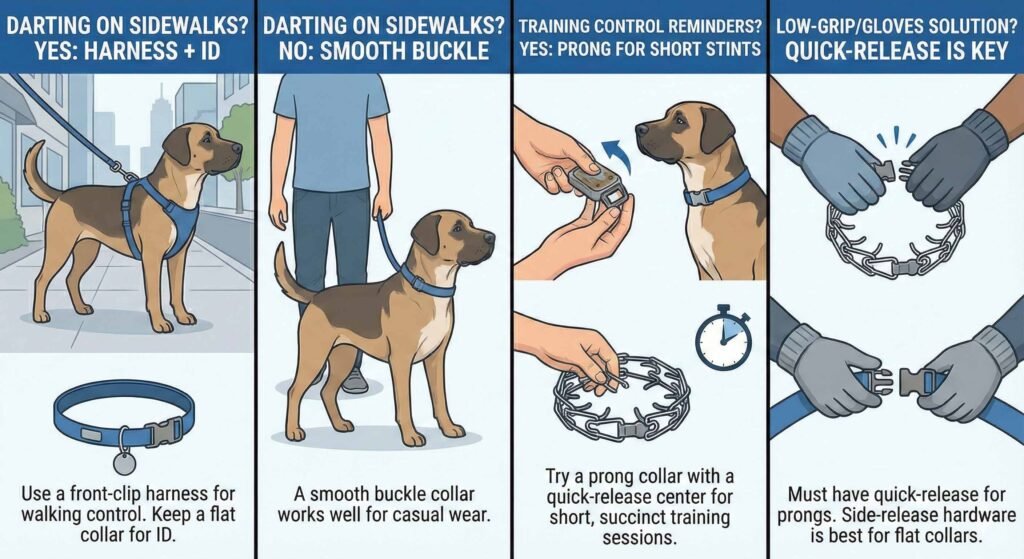
- Does your dog dart on sidewalks?
- Yes: Use a front-clip harness for walking. Keep a flat collar for ID.
- No: A smooth buckle works well for casual wear.
- Do you want short, succinct control reminders for training?
- Yes, and with help: Try a prong for short stints of training. Use a quick-release center for clean on/off.
- No: You can continue using a flat collar (ID) + harness for walks.
- You (or your folks) need a low-grip or gloves solution?
- Must have a quick-release if you are going to use with a prong. When using a flat collar, side-release hardware gives you quick deploy-ability.
Fit & Placement ( Non-Negotiable )
Flat buckle
- Fit so that you can fit two fingers between the collar and neck.
- Position mid-to-high on the neck; inspect monthly for frays, slack or elongated holes.
- If you feel compelled to do some neck handling, go short and no towing out of the collar.
Prong
- It sits high behind the ears and is straight all over.
- Adjust by adding/removing links don’t over-tighten.
- Cue-slack use; no pressure should be holding steadily.
- Opt for a quick-release center (for safer door, elevator thresholds).
Walking Setups That Actually Work
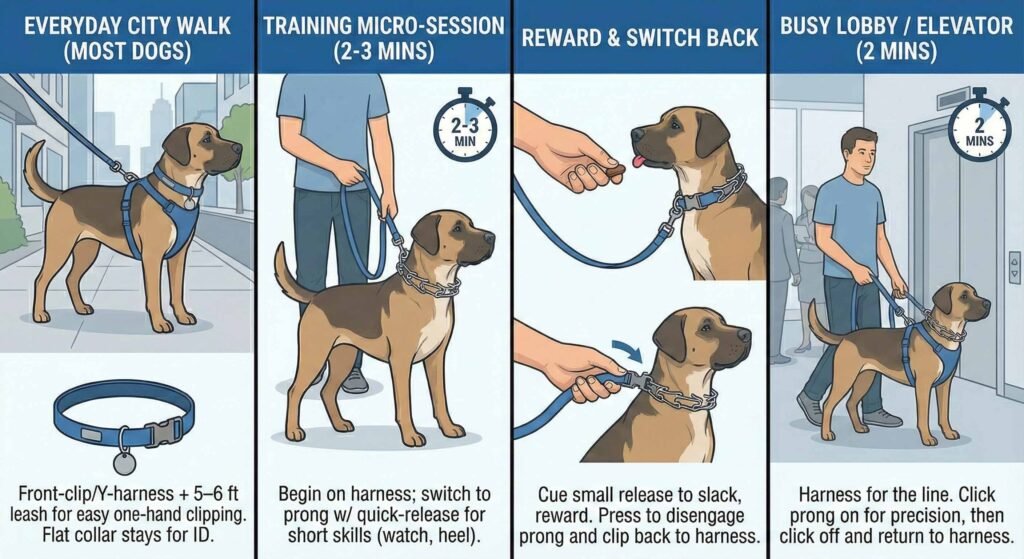
Everyday City Walk (most dogs)
- Front-clip/Y-harness + 5–6 foot leash that clips on easy with one hand.
- Flat collar stays put for iD tags.
Training Micro-Session (5–10 minutes)
- Begin on harness; switch to prong w/ quick release for 2-3 mins. of skills (watch, heel start, position).
- Cue small release to slack reward press to disengage and clip back to harness.
Busy Lobby / Elevator:
- Harness for the line.
- For when you need precision for 2 minutes. Click on the prong (quick-release) and place calmly, click off and go back to harness.
Pros & Cons Side-by-Side
| Feature | Flat Buckle | Prong (quick-release) |
|---|---|---|
| Main role | ID + calm walking | Precision training cues |
| On/Off speed | Moderate (pin) / Fast (side-release) | Fast with quick-release center |
| Learning curve | Low | High (fit + timing) |
| For pullers | Poor | Not for mileage; use harness |
| Public perception | Neutral | Can concern bystanders |
| Best pairings | Harness for walks | Harness for walks; prong for short sessions |
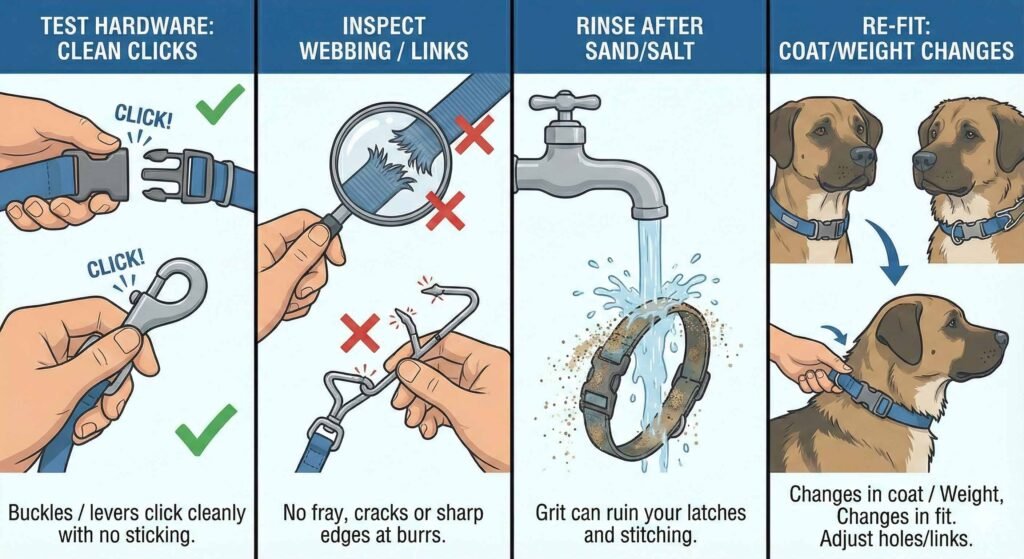
Safety & Care (30 Second Monthly Routine)
- Test hardware: Buckles / levers click cleanly with no sticking.
- Inspect webbing / links: No fray, cracks or sharp edges at burrs.
- Rinse after sand/salt: Grit can ruin your latches and stitching.
- Re-fit: Changes in coat / Weight, Changes in fit. Adjust holes/links.
Common Mistakes (Easy Fixes)
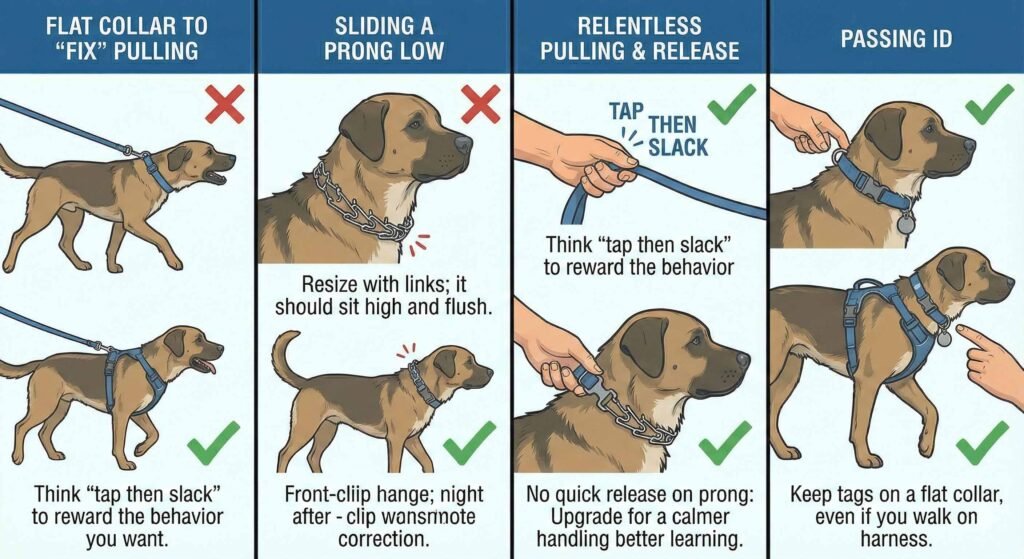
- Flat collar to “fix” pulling: Front-clip harness; train loose-leash skills independently.
- Sliding a prong low: Resize with links; it should sit high and flush.
- Relentless, ceaseless pulling on any collar ”Think tap then slack” to reward the behavior you want.
- No quick release on prong: Upgrade for a calmer handling better learning.
- Passing ID: Keep tags on a flat collar, even if you walk on harness.
First-Hand Note
The key upgrade for teams that use a prong isn’t the prongs. It’s the quick-release center. On/off is also a matter of seconds, keeping thresholds perfectly cool and sessions completely professional. For all else, a good front-clip harness and flat collar for ID are the no-drama defaults.
FAQs
Should a flat collar be my sole walking tool?
Yes if your dog is already good on the leash. If not, switch the leash for a front-clip harness and leave the collar on for ID.
Is a prong collar cruel?
The fit, and how it feels to hold in the hand, is all that matters. With the help of some coaching and cue-then-slack timing, it can speak with less force. Without that, skip it.
Will a prong fix pulling?
Not by itself. Leverage the harness for managing pulling on real-life walks; reserve your prong (if applicable) for short, coached precision.
What is the deal with “quick-release” on a prong?
Clean, fast on / off at doors and elevators, predictable emergency release and ease of use with gloves or low grip strength.
What about martingales?
Ideal for escape-artists and light catching. They don’t cure hard pullers use them for exercise, wear a harness for miles.
Final Thoughts
Select the tool based on task, not trend. Flat Buckle is your 24 / 7 ID and loose leash sat with a beautiful special friend. A prong preferably with quick-release is a specialist for short, coached reps. For everyday miles and real-world chaos, a front-clip harness frees up the neck and your handling. Wear them snug, keep your sessions brief and slack off by default.