Fact Check
Why Quick-Release Dog Leashes Make Walks Safer and Easier
Table of Contents
A quick-release leash allows you to clip on/off with a single movement whether it’s through side-release buckles, locking carabiners, or magnetic quick-connects providing faster recovery during busy lobbies, traffic moments, and panic situations. Pick the connector by durability, glove-friendliness and whether you walk your dog on a harness or collar.
Key takeaways
- Speed safety: One-hand clips eliminate fumbling in doorways, elevators, curb stops.
- Choose by use case: Auto-lock carabiner for strong dogs; magnetic quick-connect for eyes off clipping; polymer side-release for everyday ease.
- Harness collar for pullers: Transfer load to a front-clip or Y-harness; save the collar for ID.
- Monthly Rinse out anything gritty, tug test the lock and stitching/swivels.
How Do I Know If a Leash Is Quick-Release
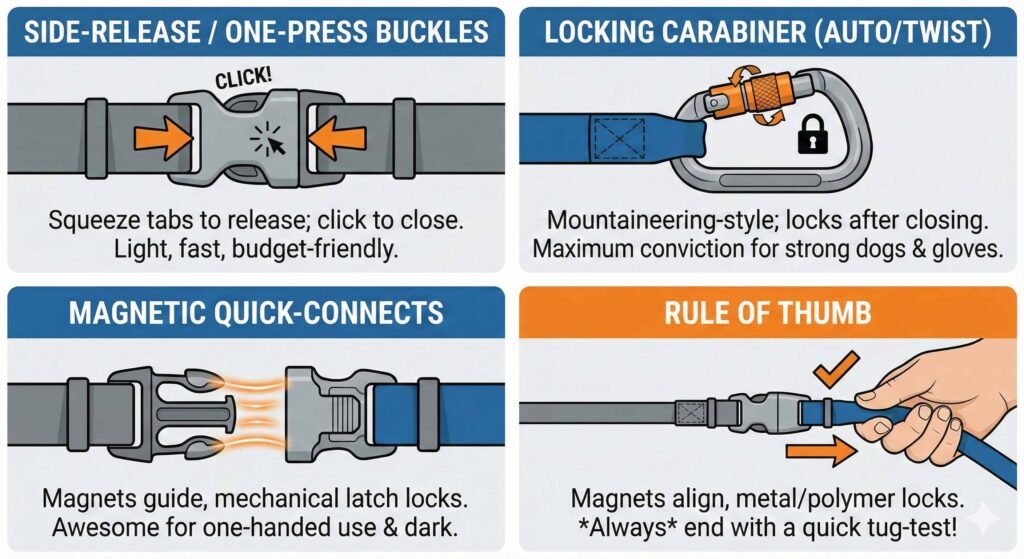
It’s not so much about the strap, as it is the connector. You’ll see three main families:
- Side-release/one-press buckles (usually plastic): Squeeze tabs to release; click to close. Light, fast, budget-friendly.
- Locking carabiner (auto-lock/twist-lock): Mountaineering-style, which locks after you close them. Maximum conviction in strong dogs and winter gloves.
- Magnetic quick-connects: the magnets help to guide and hold the two halves together, when mechanically latched press apart to release. Awesome when you’re carrying bags or clicking in the dark.
- Rule of thumb: magnets align, metal locks or polymer; always end it with a quick tug-test.
The Safety Upside (Typical Scenarios You’ll Probably Encounter)
- Doorway chaos: Your dog spots a pal; you want a quick, upbeat clip before the door closes.
- Street crossings: Hands are gloved and traffic is moving one-hand lock trumps a grab for a small gate.
- Panic moments: Snagged leash or tangled dog? Positive‑action release helps you re-center instantly without wrestling gear.
- Daycare/grooming trade: Quickly clips/unclips, helping to reduce hold times and stress on workers.
Which Connector Should You Choose?
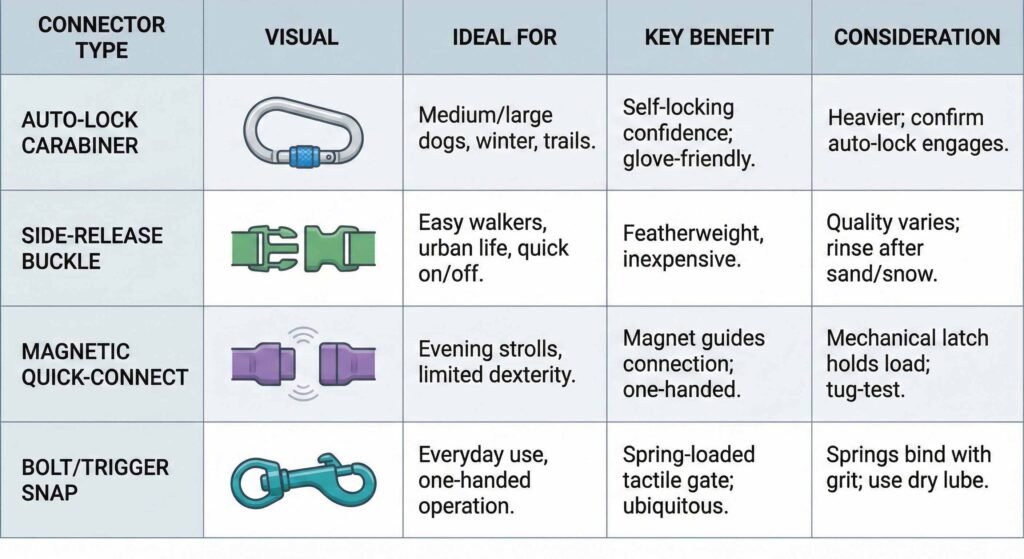
- Auto-Lock Carabiner (strength gloves)
- Ideal for: Medium/large dogs, pullers, winter, trails.
- Why: Self locking confidence; lot of target you can work by feel.
- Watch-outs: A tad heavier; confirm full auto-locking (or go with twist lock if you prefer having a manual verification).
- Side-Release Buckle (fastest everyday)
- Best for: easy walkers, ease of entry and exit, urban life.
- Why: Featherweight, cheap, quick on/off.
- Watch-outs: Quality differences; opt for recessed tabs and avoid post-sand/snow rinse.
- Magnetic Quick-Connect (eyes-off clipping)
- Best for: Evening strolls, restive pups, people with limited dexterity.
- Why: Magnet “finds” target; press to release.
- Watch-outs: The mechanical latch is what takes the load tug-test each time.
- Bolt/Trigger Snap (classic feel)
- Best for: One handed use (after you’ve learned it), everyday.
- Why: Spring-loaded tactile gate; ubiquitous and relatively cheap.
- Watch-outs: Springs can bind with grit; a drop of dry lube assists.
Clip to a Harness or Collar?
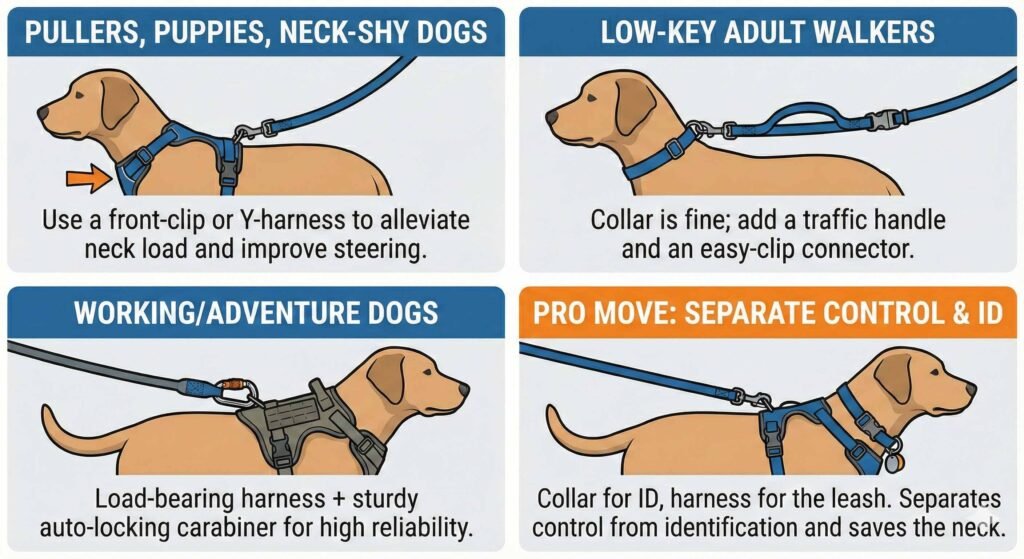
- Pullers, puppies, short-nosed or neck-shy dogs: Place harness. A front-clip or Y-harness alleviates some of this neck load and leads to calmer steering.
- Low-key adult walkers: Collar is fine; still consider a traffic handle and easy-clip connector.
- Working/adventure dogs: Load bearing harness + sturdy connector (auto locking carabiner) for high reliability.
- Pro move: Collar for ID, harness for the leash. It separates control from identification and saves your dog’s neck, too.
Everyday Load-outs
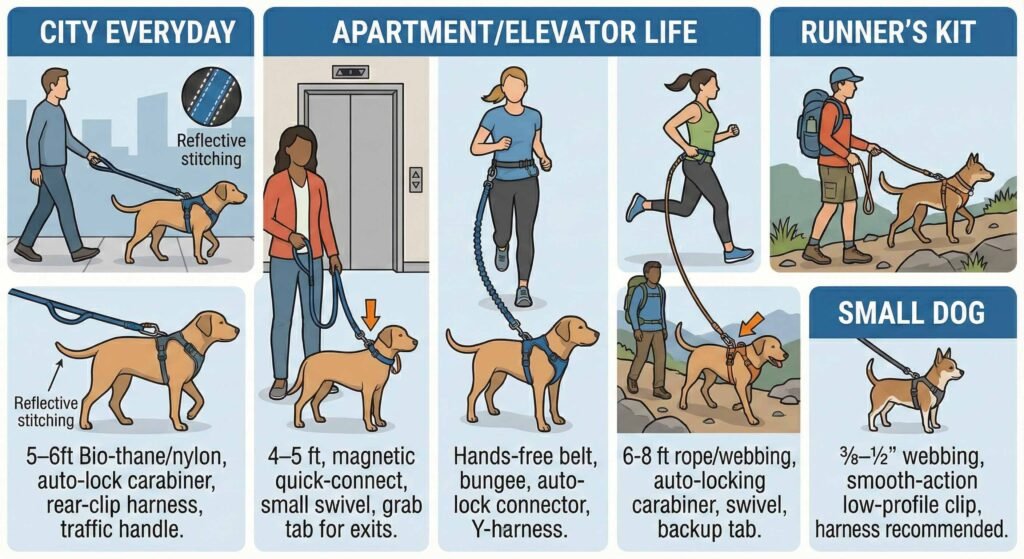
- City Everyday: 5-6ft Bio-thane/nylon auto-lock. carabiner rear-clip harness; reflective stitch & traffic handle optional..
- Apartment/Elevator Life: 4–5 ft leash magnetic quick-connect; small swivel to avoid twists; grab tab for exits.
- Runner’s Kit: Hands free belt with bungee auto-lock connector Y harness.
- Trail Dog: 6-8 ft rope/webbing / auto locking carabiner / swivel (back up tab near dog for scrambles)
- Small Dog: ⅜ – ½″ webbing smooth-action, low-profile clip; harness recommended.
Quick-Release vs Standard: What Changes Day-to-Day?
| Scenario | Standard Clip | Quick-Release Connector | Why It Matters |
|---|---|---|---|
| Busy lobby | Fumble-prone | One-hand, positive lock | Less chaos at doors |
| Winter gloves | Awkward | Big lever/auto-lock | No removing gloves |
| Night walks | Hit-or-miss | Magnetic align + latch | Eyes-off clipping |
| Strong puller | Risk of gate failure if cheap | Locking carabiner | Confidence under load |
| Crate/groom swaps | Slow | Press-to-open | Faster transitions |
Length & Material (Because Clip Isn’t Everything)
- 4 ft: Sidewalks are congested, and heel-toe drills.
- 5–6 ft: Daily sweet spot in United States.
- 8–10 ft: Decompression/sniff walks loose and controlled enough.
- Long line (15–30 ft): Remember to practice; always connect your harness.
Materials
- Webbing nylon: Versatile, light, cheap.
- Rope: Soft in the hand, good for long lines.
- Bio-thane: Waterproof, wipe it clean (great for mud/salt).
- Vegetable tanned Leather: Break-in comfort, premium feel; keep conditioned with leather balm.
Maintenance (Small Habits, Big Safety)
- After sand, salt and snow, rinse grit kills springs and buckle channels.
- Monthly check: Positive click/lock, spring action return, stitching still solid (I watch these as best I can), swivel spins.
- Dry lube metal gates easily; prevents dust and dirt buildup.
- Put gear with hairline cracks, bent gates, sticky locks or frayed bar-tacks out to pasture.
First-Hand Note
Thanks to the magnetic quick-connect, I’ve clipped a wriggly dog one-handed in a dark stairwell; on frozen trail days, the auto-lock carabiner is my superhero clip it, and it locks … no second-guessing.
FAQs about Quick-Release Dog Leashes
Can you use a quick-release leash with big dogs?
Yes–an auto-lock carabiner on 1″ webbing or rope and a front-clip harness to bring leverage to heel.
Will my dog by held in place by the magnetic connector?
Yes the magnet only aligns. The load is latched mechanically. As clips also come in super handy for fall, I do a quick tug-check after clipping always.
Side-release buckles vs carabiners. What’s better?
For speed/lightness, side-release. And to withstand heavy use, auto-lock carabiner. Many owners keep both.
What hair length to begin with?
5-6ft for most US sidewalks and parks. For your second leash, either a 4 ft for city control or an 8–10 foot for decompression).
Slip lead or standard leash?
Slip leads are good for short temporaries and training under supervision. A harness, standard leash is lighter on the neck for everyday walks.
Final Thoughts
Quick-release connectors don’t just feel better they also buy you precious additional minutes when it matters. Choose the clip you can operate blindfolded, attach it to a harness if there is pulling going on and regard maintenance like brushing your teeth: quick and on the regular. Do that and your leash will lock when you want it to, release when you need it and all while keeping walks calm.